
Views: 0 Author: Site Editor Publish Time: 2026-09-08 Origin: Site


High-fidelity audio and professional sound reinforcement demand a rigorous balancing act. You must constantly weigh sonic purity against thermal efficiency and physical footprint constraints. Traditionalists often lean toward Class AB architectures for their proven analog linearity. Meanwhile, modern integrators and audiophiles increasingly adopt Class D solutions. They do this to drastically reduce rack weight and manage extreme thermal outputs.
This split creates a persistent dilemma for system builders trying to maximize overall performance. How do you decide which technology truly suits your specific listening environment? This comprehensive guide provides an objective, evidence-based evaluation framework. We will explore how these specific topologies differ in everyday operation. You will learn to confidently select the correct amplification topology based on measurable acoustic outcomes and practical engineering requirements.
Modern Class D amplifiers match or exceed Class AB in most measurable audio quality metrics (THD+N, SNR) while operating at 80–90%+ efficiency.
Class AB remains highly relevant for ultra-critical listening environments where analog signal purity and zero switching noise are prioritized over power consumption.
For high-output and scalable setups, a Class D professional amplifier dramatically reduces cooling requirements, rack weight, and AC mains draw.
Hybrid topologies, like the Class TD power amplifier, offer a viable middle ground for specific high-demand touring applications.
To make informed audio infrastructure decisions, we must first understand basic circuit topologies. The underlying architecture dictates everything from thermal dissipation to transient response. Modern engineers evaluate these designs based on strict operational realities.
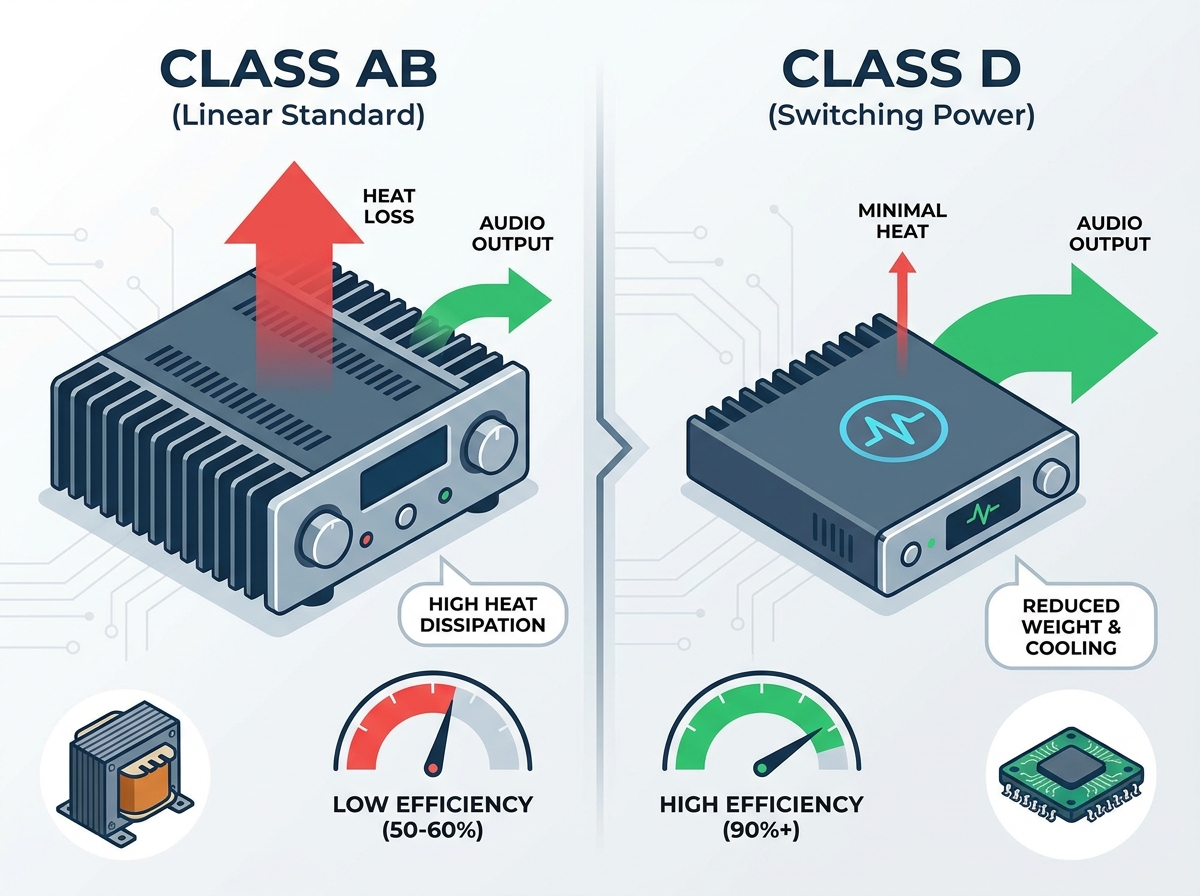
Engineers consider Class AB the traditional benchmark for analog audio reproduction. It elegantly combines two distinct operating modes. It utilizes Class A design, where output transistors remain constantly on. It also integrates Class B push-pull mechanics to handle dynamic signal swings.
This hybrid approach effectively minimizes crossover distortion. Crossover distortion occurs when the signal transitions between the positive and negative halves of the waveform. However, this analog purity creates a massive thermal penalty. The operational reality reveals significant inefficiencies. Maximum electrical efficiency rarely exceeds 50 to 60 percent. The amplifier dissipates the remaining energy as pure heat. Consequently, these units require massive extruded aluminum heat sinks. They also demand extremely heavy linear power supplies to maintain voltage stability.
Audio professionals often refer to this topology as a Switching Power Amplifier. Unlike linear designs, this architecture operates differently. It utilizes Pulse Width Modulation (PWM) to rapidly switch output transistors fully on or fully off. This binary switching process happens millions of times per second.
The operational reality here focuses on extreme energy conversion. These modules routinely achieve up to 90 percent efficiency or higher. This drastically reduces physical device weight. It virtually eliminates heavy cooling dependencies. You no longer need massive copper transformers. However, this rapid switching introduces high-frequency noise. Manufacturers must implement precise low-pass output filtering. This filter blocks unwanted switching artifacts before they reach your speakers.
Table 1: Operational Characteristics Comparison
| Topology Class | Operating Principle | Max Efficiency | Heat Dissipation Need |
|---|---|---|---|
| Class A | Always fully on | ~20-30% | Extreme |
| Class B | Push-pull operation | ~70% | Low (High Distortion) |
| Class AB | Combined analog linearity | ~50-60% | High |
| Class D | Pulse Width Modulation | 90%+ | Minimal |
Audiophile communities often debate amplifier classes using subjective terminology. We must separate historical biases from current engineering data. Objective metrics tell a much clearer story about modern performance capabilities.
We often view older switching designs through a skeptical lens. Early iterations suffered from undeniable high-frequency harshness. They also exhibited load-dependent frequency responses. This meant the amplifier sounded drastically different depending on the connected speaker impedance.
Current evidence contradicts these outdated stereotypes. Top-tier modern modules, such as those from Hypex or Purifi, utilize highly advanced feedback loops. These nested feedback systems correct errors in real time. They successfully push distortion artifacts well below the threshold of human hearing. Today, modern switching designs routinely rival the most expensive Class AB hardware in measurable THD and noise floor metrics.
Bass reproduction requires absolute mechanical control over the speaker cone. A reliable Class D Power Amplifier inherently offers exceptionally low output impedance. This mathematical relationship generates an extremely high damping factor.
A high damping factor acts like electronic brakes for your woofer. It prevents the cone from oscillating after the audio signal stops. This provides superior low-frequency control. It creates punchy, articulate, and tight bass responses. These traits make this topology ideal for dedicated subwoofers and large-scale line arrays.
Despite massive advancements, traditional linear designs still offer specific acoustic benefits. Class AB maintains a slight architectural advantage in ultra-high-frequency extension. Linear amplifiers do not require aggressive output filters to block ultrasonic noise.
This unfiltered signal path strongly appeals to analog purists. It ensures perfect phase coherence at extreme high frequencies. If you prioritize absolute high-frequency "air" and delicate cymbal decay, Class AB provides measurable, albeit subtle, advantages.
Audio fidelity only matters if you can successfully deploy the equipment. System integrators face strict physical constraints. Rack space, ambient room temperature, and available electrical panels dictate project success.
Traditional Class AB hardware requires extensive ventilation spacing. You must leave empty rack units above and below the amplifiers. Poorly ventilated equipment racks pose a severe risk of thermal shutdown. Heat accumulation will eventually trigger internal protection circuits during a performance.
Switching amplifiers completely change this dynamic. They allow for ultra-high-density racking configurations. You can pack more individual output channels per single Rack Unit (RU). This compact form factor proves ideal for integrated active speakers. It also streamlines highly scalable commercial audio installations.
Evaluating AC mains requirements is a critical step for integrators. A venue's electrical panel can only deliver a finite amount of amperage. Linear amplifiers draw significant baseline current simply to idle.
Reduced Current Draw: A multi-channel switching setup significantly lowers overall electrical demands.
Breaker Stability: It minimizes the risk of tripped breakers during high-impact audio transients.
Infrastructure Savings: Venues can avoid expensive dedicated electrical conduit upgrades.
Physical mass directly impacts transport logistics. Switching topologies reduce amplifier weight by up to 70 percent compared to Class AB equivalents. You eliminate heavy copper windings and massive aluminum fins.
This weight reduction acts as a critical cost-saving factor. Touring rigs require fewer stagehands to load equipment. Furthermore, shipping lighter audio racks internationally dramatically reduces freight expenses.
Engineers constantly seek the perfect compromise between linear purity and switching efficiency. This pursuit led to hybrid architectures. A Class TD Power Amplifier bridges the gap between historical topologies.
This represents a proprietary hybrid topology designed for extreme environments. It utilizes a highly intelligent switching power supply. This supply dynamically tracks the incoming audio signal amplitude. It then adjusts the internal rail voltage instantly.
This fluctuating voltage feeds directly into a traditional Class AB output stage. The output stage only receives the exact voltage it needs at any given millisecond. This prevents excess energy from turning into wasted heat.
System architects must carefully evaluate this hybrid approach. It provides undeniable benefits alongside specific operational risks.
Sonic Benefit: Delivers the pristine sonic characteristics of Class AB operation.
Efficiency Gain: Achieves electrical efficiency levels rapidly approaching modern switching designs.
Implementation Risk: Relies on highly complex internal circuitry.
Maintenance Need: Requires specialized technicians for proper field repairs.
Manufacturers typically reserve this topology for top-tier professional touring rigs. It makes sense where production budgets easily allow for specialized preventative maintenance.
Selecting the ideal audio infrastructure requires honest application matching. You must align the technological strengths with your specific environmental demands.
Modern residential spaces present unique challenges. Multi-channel immersive audio requires numerous discrete amplifier channels. We recommend high-end switching designs for Dolby Atmos and multi-channel surround processing. This choice saves critical cabinet space and prevents dangerous heat buildup inside enclosed media furniture.
Conversely, we recommend reserving Class AB hardware for dedicated two-channel setups. If your primary goal involves critical vinyl listening, traditional linear amplifiers still offer unmatched analog purity.
The rigorous demands of live production require brute force and supreme reliability. A Class D Professional Amplifier stands as the undisputed choice here. The immediate return on investment regarding transport weight is undeniable.
Switching architectures simplify stage rigging. They allow line arrays to carry onboard amplification modules safely. Furthermore, their lower power consumption keeps venue electrical grids stable. These massive logistical benefits heavily outweigh any negligible differences in high-frequency airiness.
Restaurants, corporate campuses, and retail spaces require constant background audio. We strongly recommend switching power amplifiers for these environments. They seamlessly facilitate cool-running, multi-zone installations.
Integrators can safely lock these units inside enclosed AV closets. The low thermal output prevents equipment failure. Additionally, this high efficiency ensures strict compliance to modern corporate energy consumption standards.
Choosing the correct amplification topology should never rely on outdated industry myths. The "best" amplifier class depends entirely on your specific deployment environment. Class AB firmly remains the benchmark for legacy analog purity. It excels in controlled, critical listening rooms where thermal constraints do not apply.
However, modern engineering has objectively solved the historical flaws of early switching architectures. Through advanced feedback loops and superior filtering, switching modules deliver incredible acoustic transparency. This technological maturity makes them the pragmatic standard for 90 percent of modern audio applications.
Before you finalize your equipment shortlist, take practical next steps. Audit your available physical rack space closely. Accurately measure your ambient cooling capabilities. Finally, evaluate your primary audio sources. Let these tangible metrics guide your ultimate investment decision.
A: Focus on verifiable data. Modern, well-implemented Class D hardware is acoustically transparent. It adds virtually no coloration to the signal. Any perceived "clinical" sound is usually a direct result of highly accurate source reproduction. It reflects the recording itself rather than an inherent amplifier flaw.
A: Historically, yes. Early iterations suffered from noticeable high-frequency distortion, making them suitable only for low-end reinforcement. Today, the technology has evolved dramatically. Full-range switching amplifiers now serve as the undisputed standard in premium studio monitors and expensive audiophile setups.
A: The weight comes directly from thermal and electrical demands. You must address the physical requirements of heavy copper transformers. Additionally, these units need massive extruded aluminum heatsinks. These large metal components are mandatory to manage the 40 to 50 percent energy loss expelled purely as heat.


