
Views: 0 Author: Site Editor Publish Time: 2026-09-30 Origin: Site


Audio enthusiasts and system integrators face a familiar decision-stage bottleneck. You must choose between the streamlined convenience of an all-in-one unit and the uncompromised headroom of separate components. Making the wrong choice carries high stakes. A poor decision often leads to underpowered, clipping speakers. Conversely, you might waste your budget on unnecessary modularity. You need a transparent, specification-driven framework to evaluate both paths. We will explore how to make this critical choice based on actual speaker demands, system scalability, and installation constraints. By understanding the core architectural differences, you can match your amplification strategy perfectly to your listening goals. You will learn exactly when dedicated muscle is required and when a unified chassis makes more practical sense. Our guide breaks down the performance metrics you need to build a flawless audio system.
An integrated amplifier combines a preamplifier and a power amplifier into a single chassis, prioritizing space efficiency and ease of use.
A dedicated power amplifier handles only signal magnification, providing superior current delivery for low-impedance or difficult-to-drive speakers.
Choosing separates (preamp + power amp) isolates sensitive low-voltage signals from high-current power supplies, reducing noise floor and interference.
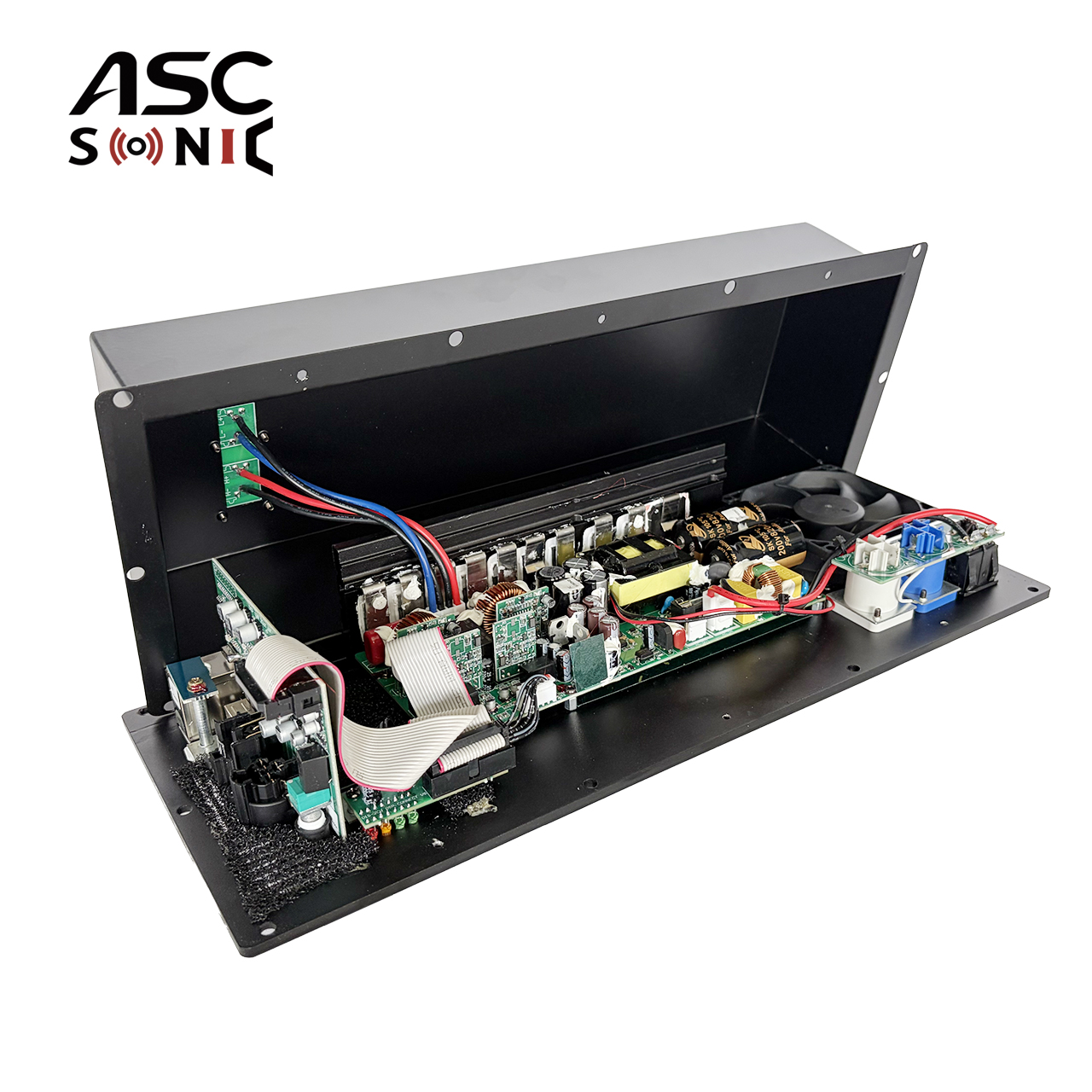
Advanced active setups increasingly rely on specialized solutions like a DSP plate amplifier rather than traditional rack-mounted units.
Let us examine the integrated approach first. An integrated unit acts as the central brain of your audio system. It houses source selection, volume control, and signal magnification within one chassis. You get a preamplifier stage and an amplification stage working closely together. Manufacturers design these units to prioritize space efficiency. They also want to maximize ease of use for the consumer.
However, engineering this unified box involves strict physical trade-offs. The preamp and output sections usually share a single internal power supply. Internal proximity can introduce electromagnetic interference (EMI). High-end models mitigate this EMI quite well using heavy internal shielding. Still, the fundamental architecture forces low-voltage analog circuits and high-current transformers to share limited real estate.
Now consider the separates approach. A dedicated Power Amplifier handles a single, highly specialized job. It acts as a pure muscle unit. Its core function is strictly magnifying the audio signal. It takes a low-level voltage signal from a dedicated preamplifier. Then, it converts this into speaker-level voltage and current. You completely remove source switching, phono stages, and volume knobs from this chassis.
This strict separation brings unavoidable form factor realities. You will require a completely separate preamplifier device. You must buy extra interconnect cables to link them. The dual-chassis setup demands significantly more rack or shelf space. You essentially trade user convenience for uncompromised circuit isolation and massive power reserves.
When does splitting these components actually matter to your ears? You must evaluate speaker sensitivity and impedance dips. Speaker impedance is rarely a flat, stable 8 ohms. It fluctuates wildly across different frequencies. Many popular tower speakers dip down to 4 or even 2 ohms in the heavy bass region.
Integrated units often look perfectly fine on 8-ohm paper specifications. However, a dedicated unit sustains its performance during severe impedance drops. Current delivery becomes the outcome-focused metric here. Massive dedicated toroidal transformers and large capacitor banks provide this necessary current. When the speaker demands sudden energy, the separate unit delivers it effortlessly.
Let us look at dynamic headroom next. Total Harmonic Distortion plus Noise (THD+N) usually rises sharply when a system struggles. Dedicated units feature larger power reserves. They deliver completely distortion-free transient peaks during demanding tracks. Cinematic action sequences also rely heavily on this massive headroom. The sound remains clean and impactful instead of turning harsh or compressed.
Noise floor management represents another major performance factor. Highly sensitive speakers, like horn-loaded designs, easily reveal background hiss. Removing the noisy power stage to an external box measurably lowers this noise floor. You isolate sensitive low-voltage DAC signals from high-current power supplies. This yields a "blacker" background for critical, low-volume listening.
| Performance Metric | Typical Integrated Architecture | Dedicated Separates Architecture |
|---|---|---|
| Current Delivery (4 Ohms) | Often limited; may trigger thermal protection circuits | High sustained current; highly stable operation |
| Dynamic Headroom | Moderate; suitable for average residential listening levels | Exceptional; easily handles extreme transient peaks |
| Noise Floor (EMI Isolation) | Average; shared power supply increases noise risk | Excellent; physical separation ensures a clean signal path |
| Component Lifespan | Heat trapped in one box can dry out capacitors faster | Better thermal dissipation extends component life |
Audio technology has moved far beyond just standard rack units. You now have several advanced format choices. The traditional External Power Amplifier remains a classic, highly respected choice. It uses a standard metal chassis placed on an AV rack. This model is best for traditional passive hi-fi setups. It also dominates modular home theater installations. Enthusiasts love it because component swapping remains a long-term goal. You can easily upgrade your surround processor while keeping your trusted amplification blocks untouched.
However, modern audio engineering offers a compelling alternative category. Let us introduce the Plate Amplifier Module. This format integrates the amplification circuitry directly into the rear of the speaker or subwoofer cabinet. You effectively build a fully active speaker system. This approach completely eliminates long speaker wire runs across your floor. It also avoids crossover power loss typically found in passive setups. The amplifier connects directly to the driver voice coils for maximum damping and control.
Pro-audio integrators and active speaker builders often take this concept a step further. They leverage the DSP Plate Amplifier advantage. Digital Signal Processing (DSP) completely transforms system tuning. Onboard DSP allows for exact time and phase alignment between drivers. It provides incredibly deep room correction capabilities. You get precise, customizable crossover mapping. External passive systems cannot easily match this level of granular control. A DSP unit actively shapes the frequency response to overcome poor room acoustics. It maximizes driver performance while rigidly protecting against mechanical over-excursion.
Choosing separates introduces new technical challenges. You must carefully navigate gain matching and impedance compatibility between components.
Common Mistake: Buyers often ignore input sensitivity ratings. A severe mismatch between a preamplifier's output voltage and an amplifier's input sensitivity causes major issues. You might experience a high, audible noise floor. Alternatively, you might lack enough volume even when turning the dial to maximum.
You must also carefully consider the "Cable Tax." Separates have hidden financial costs. You cannot just use basic copper wires.
Interconnects: You need high-quality RCA or Balanced XLR cables to link the preamp to the amplifier cleanly.
Power Cords: You now have two distinct, power-hungry components demanding premium power delivery cables.
Rack Accessories: You might need extra vibration-damping feet or specialized, heavy-duty rack shelves.
These additions easily increase your overall project budget by 10% to 20%.
Space and thermal management present hard implementation realities as well. Dedicated output stages generate significant heat. Class A and Class AB designs get particularly hot during extended operation.
Best Practice for Thermal Management:
Never stack heat-producing amplifiers directly on top of preamplifiers or source gear.
Avoid placing them inside closed, unventilated AV wooden cabinets.
Leave at least three to five inches of vertical clearance above the chassis cooling vents.
Ignoring these thermal rules leads to early thermal clipping. In severe cases, you risk complete hardware failure and blown protection fuses.
How do you make the final, correct call? You can simplify the buying process using strict, objective criteria. Shortlisting the right unit depends heavily on your specific room constraints and equipment.
Criteria for Choosing an Integrated Amp:
High Speaker Sensitivity: Your speakers have high sensitivity ratings (typically 90dB or higher). They do not require massive current dumps to come alive and play loud.
Physical Constraints: Space and aesthetic simplicity act as your primary project constraints. You want fewer boxes and fewer messy wires in your living space.
Strict Budgets: Your total budget prevents buying two high-quality separate chassis. A single well-engineered unit provides much better sonic value than two mediocre, cheap separates.
Criteria for Choosing a Power Amplifier:
Demanding Loads: Your speakers are notoriously difficult to drive. Examples include large electrostatic panels, planar magnetics, or low-sensitivity tower speakers.
Upgrade Pathways: You plan to incrementally upgrade the system over many years. You might swap preamps for new DAC technology while keeping your heavy amplification untouched.
Specialized Tuning Needs: The application requires dedicated DSP tuning and active crossovers. In this scenario, favoring active modules gives you surgical audio control over the soundstage.
Let us summarize our final assessment. An integrated unit is not inherently worse than separate components. It represents a carefully engineered compromise for efficiency, space, and convenience. Many flagship unified models deliver breathtaking, audiophile-grade sound. On the other hand, separate amplification is a dedicated investment. It provides unconstrained headroom, superior thermal stability, and ultimate system modularity over the decades.
Your next steps require practical action. Check your specific speaker's minimum impedance rating first. Do not just look at the nominal 8-ohm label on the back. Next, verify the manufacturer's recommended wattage range. Gather these two vital metrics before shortlisting any specific models. This data-driven approach guarantees you will purchase the exact amount of clean power your audio system truly needs to thrive.
A: Yes, many mid-to-high-end models feature "Pre-Out" connections on the rear panel. These outputs allow you to bypass the internal power stage entirely. You can send the volume-controlled, line-level signal directly to a separate, more powerful external amplifier. This offers an excellent, cost-effective upgrade path.
A: Not automatically. A poorly designed separate will sound much worse than a flagship integrated model. Build quality always dictates the actual sound. However, the separated architecture dictates the potential. By isolating the power supply and reducing thermal limits, separates generally offer higher potential for distortion-free dynamic peaks.
A: Adding a 2-channel or 3-channel unit via the receiver's pre-outs greatly improves performance. Home theater receivers share one internal power supply across 7 to 11 channels. Offloading the demanding front left, right, and center speakers relieves the receiver's power supply. This vastly improves overall front-stage dynamics and clarity.


