
Views: 0 Author: Site Editor Publish Time: 2026-08-25 Origin: Site


In custom loudspeaker and subwoofer design, the method of power delivery dictates acoustic performance, structural engineering, and thermal management. System integrators and DIY audio builders face a strict choice. You either embed amplification directly into the enclosure or rely on outboard rack-mounted gear. This decision forces a compromise between aesthetic integration, thermal management, component lifespan, and system scalability. We will break down the engineering realities of the active plate amplifier versus the external power amplifier. We evaluate both architectures on thermal dynamics, DSP integration, reliability, and scalability to determine the optimal solution for specific deployment environments. You need to know exactly how these components behave under heavy load, how they handle mechanical stress, and what happens when a part inevitably fails.
Integration vs. Isolation: Active plate amplifiers offer a streamlined, all-in-one footprint that eliminates external cabling, whereas external power amplifiers isolate sensitive electronics from destructive cabinet vibrations.
Thermal Realities: External amplifiers generally provide superior thermal management and higher duty cycles under heavy loads, making them preferable for sustained, high-SPL applications.
DSP Flexibility: Modern plate amplifiers frequently include integrated DSP and physical filtering controls for precise, enclosure-specific tuning, while external amps require outboard processors but offer broader upgrade paths.
Maintenance and Lifespan: External amplifiers offer easier servicing and replacement. Plate amplifiers require careful matching of enclosure cutouts if a replacement is needed post-failure, a common pain point in the DIY community.
An active plate amplifier operates as a self-contained power supply, amplifier circuit, and control interface mounted directly to a metal backplate. This assembly integrates directly into the speaker cabinet. It forms part of the enclosure's physical boundary, effectively sealing the box while converting a passive speaker into a fully active system. The metal plate itself serves a dual purpose. It acts as the structural mounting point and the primary heatsink for the internal electronic components.
These units typically include physical knobs for gain adjustment, phase alignment, and low-pass filtering. Manufacturers design specific models based on the intended frequency response. Subwoofer-specific models focus heavily on low-frequency extension and bass boost equalization. Conversely, a Full Range Plate Amplifier is engineered for multi-way active monitors or PA tops. It provides crossover networks suitable for tweeters and mid-range drivers alongside the main woofer, allowing builders to construct fully active two-way or three-way speaker systems without external crossovers.
Installing this hardware requires cutting a precise rectangular hole in the speaker cabinet, usually through 3/4-inch or 1-inch MDF. You must ensure an airtight seal using closed-cell EVA foam gaskets or rubber weatherstripping. Any air leaks around the perimeter of the aluminum flange will cause audible chuffing and compromise the acoustic suspension of sealed enclosure designs. The internal wiring connects directly from the amplifier board to the speaker driver's push terminals, keeping the high-voltage speaker wire entirely contained within the box.
External power amplifiers function as standalone units requiring dedicated rack space or shelving. Often referred to as "Pro Amps" or rack-mount amplifiers, these units separate power delivery entirely from the acoustic enclosure. This separation necessitates a passive speaker design, where the cabinet contains only the speaker drivers, internal wiring, and a rear terminal cup. All amplification is handled remotely.
These amplifiers utilize various circuit topologies depending on the application. Class AB amplifiers are known for excellent sound quality and lack of crossover distortion, but they are highly inefficient and generate significant heat, requiring massive copper transformers and heavy aluminum heatsinks. Class D amplifiers are highly efficient, utilizing pulse-width modulation. They run cool and offer massive power output in lightweight chassis, making them the modern standard for heavy subwoofer applications. Class H amplifiers utilize rail-switching technology to increase efficiency over Class AB while maintaining similar audio characteristics, often found in heavy-duty live sound environments.
External amplifiers dominate home theater racks and live sound reinforcement systems. They require standard 19-inch equipment racks. You must run heavy-gauge speaker wire, typically 12 AWG or 10 AWG oxygen-free copper, to transmit the amplified signal across the room to the passive cabinets. Connections are usually made via robust Neutrik Speakon connectors or heavy-duty binding posts to ensure secure, low-resistance signal transfer.
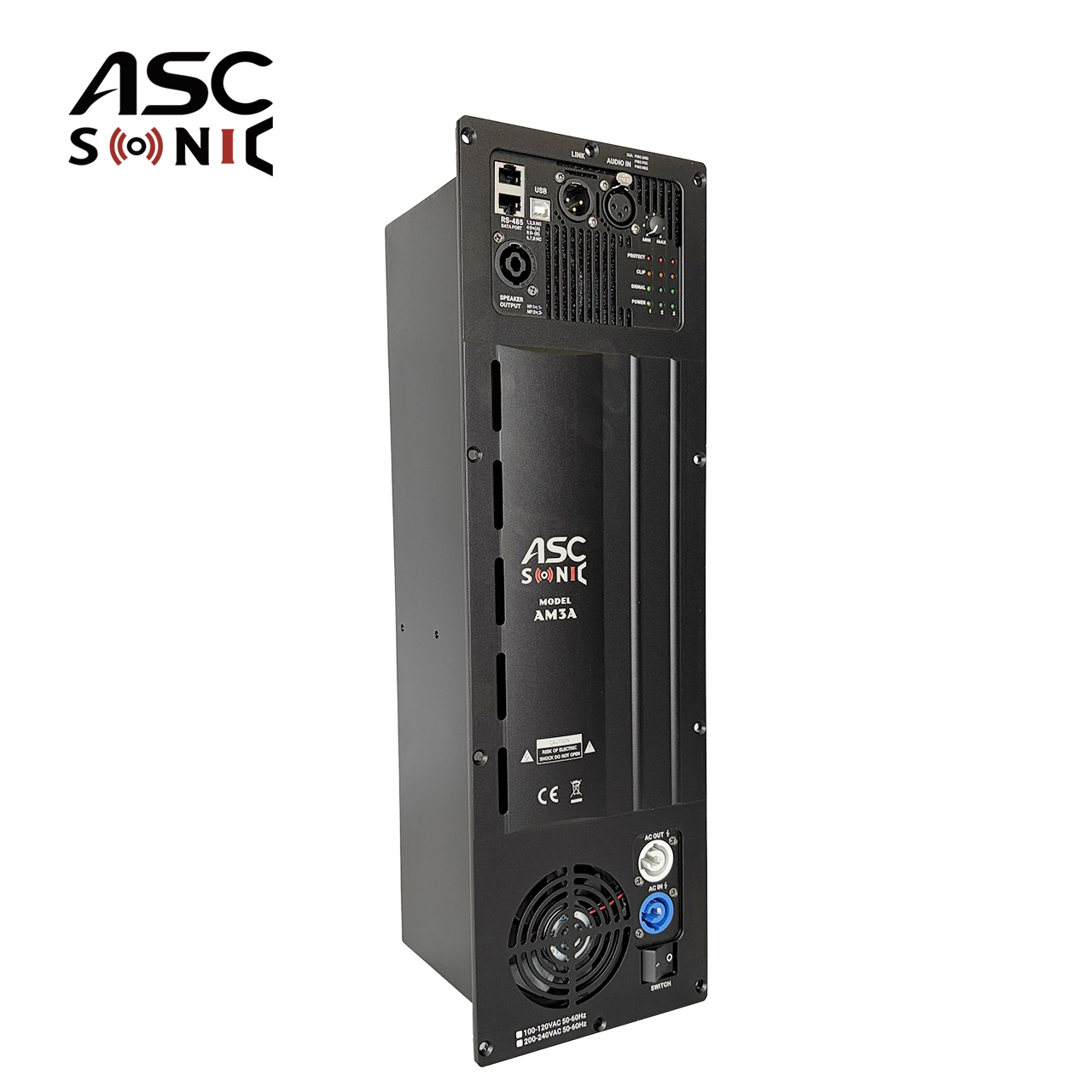
Thermal management defines the operational limits of any amplifier. Plate amplifiers rely primarily on their external metal plate as a heatsink. In some designs, they also utilize the internal air volume of the speaker cabinet for cooling. This creates a significant engineering challenge. In sealed, heavily stuffed enclosures, the internal air acts as an insulator rather than a coolant. As the speaker driver's voice coil generates heat, the internal cabinet temperature rises rapidly. The amplifier components bathe in this trapped heat. During extended playback at high volumes, this thermal soak leads to thermal throttling or premature shutdown as the internal sensors cut power to protect the circuitry.
External amplifiers operate under entirely different thermal conditions. They sit in open air or ventilated equipment racks. High-powered pro amps utilize active fan cooling, pulling ambient air across large, internal aluminum heatsinks. Twin 80mm fans can push 50 CFM of air directly over the output transistors. This forced-air convection allows external amplifiers to maintain extended high duty cycles without thermal shutdown. They can push massive continuous wattage for hours during live events or intense movie sequences without breaking a sweat.
Thermal stress directly accelerates component degradation. Electrolytic capacitors dry out faster at elevated temperatures, losing their capacitance and increasing equivalent series resistance (ESR). The differences between these two amplifier types become most obvious at their thermal and output limits. An external amplifier will sustain its maximum output far longer than a comparable plate amplifier trapped inside a hot wooden box.
The primary engineering critique of plate amplifiers centers on their exposure to extreme internal cabinet pressure and mechanical vibration. A high-excursion 15-inch or 18-inch subwoofer driver operating inside a compact enclosure generates violent internal air pressure changes and massive physical shaking. The cabinet walls flex, and the plate amplifier takes the full force of this mechanical energy.
Constant vibration wreaks havoc on printed circuit boards (PCBs). Over time, this mechanical stress leads to cold solder joints. Heavy components like large filter capacitors, copper inductors, and transformers can literally vibrate loose, shearing their leads off the board. Relays can become compromised, leading to intermittent signal loss or loud popping noises. High-end manufacturers attempt to mitigate this by covering sensitive components in thick potting compound or silicone adhesive, but the underlying physical stress remains a constant threat to longevity.
This harsh operating environment fuels a prevalent concern within the DIY audio community. Many builders default to passive subwoofer designs specifically to avoid this failure point, knowing that electronics and violent vibration do not mix well.
External amplifiers completely bypass this risk. By physically isolating the sensitive electronics from the acoustic energy source, the amplifier operates in a stable, vibration-free environment on a rack shelf. This isolation drastically extends the lifespan of the internal components, making external amplification the preferred choice for maximum long-term reliability.
Amplifiers face severe electrical stress when driving low-impedance loads, such as 2-ohm configurations or dual 4-ohm voice coils wired in parallel. As impedance drops, the amplifier must deliver significantly more current to maintain voltage output. The amplifier sees a load that is dangerously close to a dead short.
Heavy external pro amplifiers typically feature massive, robust power supplies. They utilize large toroidal transformers and extensive capacitor banks capable of delivering massive current reserves on demand. They handle low impedance dips with ease, maintaining a high damping factor and tight control over the speaker cone even when pushed to their operational limits. They grip the driver and force it to stop moving the instant the signal stops.
Compact plate amplifiers utilize highly optimized, but sometimes strictly limited, switch-mode power supplies. While modern Class D plate amps are incredibly efficient, their power supplies are often engineered to meet a specific price point and physical size constraint. When pushed to maximum output into a low-impedance load, some plate amplifiers may experience voltage sag. They might engage aggressive internal limiters to protect the circuitry, resulting in compressed dynamics and a lack of punch during heavy bass transients.
Modern plate amplifiers offer exceptional convenience through onboard Digital Signal Processing (DSP). This technology replaces traditional analog filtering networks with precise digital control. Manufacturers factory-calibrate these DSP profiles to match the exact electromechanical parameters of the specific driver and enclosure combination, ensuring flat response right out of the box.
Integrated DSP provides builders with powerful tuning capabilities directly at the speaker. You can set a high-pass filter at 20Hz with a 24dB/octave Butterworth slope to protect the driver from mechanical over-excursion below the port tuning frequency. You can apply Parametric EQ (PEQ) to target specific frequencies, adjust the bandwidth (Q), and apply precise cuts to flatten a nasty 50Hz room mode. Phase alignment offers variable control from 0 to 180 degrees, or precise time delay settings in milliseconds, to perfectly integrate the subwoofer with the main speakers.
Many advanced plate amplifiers feature software interfaces. You connect via a USB cable or Wi-Fi to adjust these parameters using a laptop or smartphone app. You see the frequency response graph change in real-time as you drag the EQ points. This creates a sleek, all-in-one tuning solution without requiring additional hardware in the signal chain.
Traditional external power amplifiers usually lack advanced onboard processing. They are designed to do one thing: take a small signal and make it massive. To achieve the same level of control as a DSP-equipped plate amp, you must insert a separate outboard DSP unit into the signal chain. Popular standalone processors include the MiniDSP 2x4 HD or the Behringer DCX2496.
This approach introduces added complexity. You must carefully manage gain staging between the AV receiver, the DSP unit, and the power amplifier to maximize the signal-to-noise ratio and prevent clipping. Consumer AV receivers output an unbalanced RCA signal at around 0.9V. Pro amps expect a balanced XLR signal at 1.4V or higher. You have to use level-matching boxes or specific DSP units that can boost the voltage. It also requires wiring a maze of interconnect cables, increasing the potential for ground loops and 60Hz hum.
However, outboard DSP offers a distinct advantage in modularity. You can upgrade your processing hardware without replacing the amplifier, and vice versa. If a new DSP technology with advanced room correction like Dirac Live emerges, you simply swap the processor while retaining your high-powered external amplifier.
The aesthetic benefits of an active plate amplifier are highly desirable for residential spaces. By housing all electronics inside the speaker cabinet, you achieve a clean, minimalist room footprint. This design eliminates the need for bulky external receivers and dedicated equipment racks taking up valuable floor space in a living room.
This all-in-one approach significantly increases the Wife Acceptance Factor (WAF) in shared living spaces. A powered subwoofer requires only two connections. You run a standard power cable to the nearest wall outlet and a single line-level interconnect, usually an RCA or XLR cable, from the source equipment. It completely eliminates the need to route long, heavy-gauge speaker wires across the room, under rugs, or through the drywall.
For active studio monitors, this form factor is essential. Sound engineers require self-contained units that can be easily positioned on mixing desks or monitor stands. They need to move the speakers around the studio without dragging external amplifier racks and thick speaker cables with them.
Deploying external amplifiers requires careful spatial planning. These units demand dedicated rack space. A standard home theater setup might require a full-height 42U server rack to house the AV receiver, multiple pro amps, DSP units, and media players. This necessitates a dedicated equipment closet with its own ventilation system or a large footprint in the viewing room.
Cable management presents a massive physical challenge. You must route thick speaker cables from the rack location to each passive speaker and subwoofer. Pulling 12 AWG wire through insulated walls requires specialized tools and significant labor. Terminating these thick cables requires robust connectors to ensure secure, low-resistance connections that won't pull out if tripped over.
Furthermore, fan noise remains a critical issue. High-powered external pro amps are designed for noisy live sound environments like stadiums and concert halls. Their stock cooling fans often run loud and fast. In a quiet home theater environment, this fan noise sounds like a jet engine and ruins the audio experience during silent movie scenes. Many home theater enthusiasts resort to opening the chassis and modifying their pro amps with quieter aftermarket computer fans, which immediately voids the manufacturer's warranty and risks electrocution if the capacitors are not discharged.
When evaluating the initial hardware acquisition, a high-quality active plate amplifier often presents a streamlined upfront cost for a single-subwoofer build. You purchase one module that handles power, processing, and connectivity. Conversely, the external route requires purchasing the amplifier chassis, a separate DSP unit, rack mounting hardware, specialized speaker cabling, and Speakon connectors.
However, maintenance realities shift the perspective entirely. Electronic components inevitably fail. If an external amplifier fails, the repair process is simple. You unplug it, unscrew it from the rack rails, slide it out, and swap in a replacement. The passive speaker cabinet remains untouched, fully functional, and exactly where you placed it.
If a plate amplifier fails, the repair process is highly disruptive. You must remove the dead amplifier from the cabinet, exposing the internal wiring. Finding a replacement with the exact same physical dimensions is notoriously difficult, especially if the original model is discontinued. If the new amplifier is smaller, you must fabricate a custom wooden adapter plate, paint it to match, and seal it. If the new amplifier is larger, you must use a router to enlarge the hole in the finished cabinet. This generates sawdust in your living room and risks damaging the enclosure's expensive veneer or paint finish. This physical hardware dependency is a major frustration for long-term maintenance.
External amplifiers offer vastly superior scalability for multi-subwoofer setups. Dedicated home theaters often utilize two, four, or even eight subwoofers to smooth out room modes and achieve uniform bass response across all seating positions. One large external amplifier can often power multiple passive subwoofers simultaneously. By wiring cabinets in series or parallel, a single two-channel pro amp can drive four passive subwoofers effortlessly. This drastically reduces the hardware footprint and simplifies the signal chain.
Plate amplifiers limit you to a strict 1:1 amplifier-to-speaker ratio. If you want four subwoofers, you must purchase four separate plate amplifiers. You must run four separate power cables to wall outlets, potentially overloading a single 15-amp household circuit. You must route four separate RCA cables around the room. This architecture scales poorly in massive multi-channel arrays, creating unnecessary redundancy, wiring clutter, and ground loop headaches.
Amplifier Architecture Comparison Summary
| Feature | Active Plate Amplifier | External Power Amplifier |
|---|---|---|
| Form Factor | Integrated into cabinet | Standalone rack-mount unit |
| Thermal Management | Relies on metal plate; prone to heat soak | Active fan cooling; handles high duty cycles |
| Vibration Exposure | High (mounted directly to acoustic source) | Zero (physically isolated on a rack) |
| DSP Integration | Often built-in; factory calibrated | Requires outboard DSP unit |
| Cabling Requirements | Power cable and line-level RCA/XLR | Heavy-gauge speaker wire from rack |
| Replacement Difficulty | High (requires matching cabinet cutout) | Low (simple rack swap) |
| Scalability | 1:1 ratio only | Can power multiple passive cabinets |
The integrated approach solves specific spatial and aesthetic problems. Choose this architecture when building standalone powered subwoofers for living rooms or family spaces where equipment racks are unacceptable. It is the mandatory choice for active studio monitors and portable PA speakers that require rapid setup and teardown.
Aesthetic priority and high WAF requirements.
Single-unit deployment rather than multi-cabinet arrays.
Desire to eliminate external equipment racks and thick speaker cabling.
Preference for integrated DSP tuning via a single software interface.
The isolated approach prioritizes raw performance and durability. Choose this architecture for dedicated home theater rooms equipped with AV closets, massive multi-subwoofer arrays, infinite baffle setups, and high-SPL live sound reinforcement.
Requirement for maximum reliability and component lifespan.
Sustained high duty cycles at extreme volume levels.
Easy serviceability and zero risk to the finished speaker cabinet upon failure.
Modular upgrade paths for separate DSP and amplification stages.
Calculate your total required RMS wattage and determine if a single plate amplifier can meet that demand without thermal throttling.
Measure your available floor space to see if a dedicated equipment rack is feasible for housing external amplifiers and DSP units.
Inspect your enclosure design to ensure it can safely accommodate the physical cutout of a plate amplifier without compromising structural integrity or internal air volume.
Map out your power outlet locations to verify you have adequate circuits to support multiple active cabinets if you choose the integrated route.
A: While modern Class-D plate amps are highly efficient, they can run hot in small, sealed enclosures driven at high volumes. They lack the forced-air cooling found in external amps and rely solely on their metal backplate to dissipate heat, which can lead to thermal throttling under heavy loads.
A: Building a passive subwoofer and pairing it with a reliable external pro amplifier mitigates the risk of internal component failure from vibration and heat. This approach offers a much more durable long-term solution for heavy users who push their systems to the limit.
A: Full-range models lack the specific low-pass filters and bass-boost EQs built into subwoofer-specific plate amps. While they can physically power a subwoofer driver, they require an external DSP to properly cross over the frequencies and shape the low-end response.
A: Builders prefer external amps for their higher reliability, superior active cooling, and complete isolation from destructive cabinet vibrations. They also handle low impedances better at output limits and can power multiple passive cabinets from a single rack unit.
A: Yes, replacing a failed plate amp is challenging because you must match the exact physical cutout dimensions in the wood cabinet. If the original model is discontinued, you often have to use custom routing tools to enlarge the hole or build adapter plates.
A: Most modern, mid-to-high-tier plate amplifiers feature built-in DSP and physical filtering controls, eliminating the need for outboard processing. However, basic analog plate models may still require an external EQ to properly flatten the in-room response.


