
Views: 0 Author: Site Editor Publish Time: 2026-09-16 Origin: Site


Every electronic signal chain ends at a critical final stage. You need immense current to physically drive heavy loads like commercial speakers, RF antennas, or industrial motors. A weak final link compromises your entire setup. Finding the right balance of electrical efficiency, thermal management, and signal fidelity remains a constant challenge. Under-specifying your gear causes hard clipping, rapid component failure, and ultimately ruins overall system performance. Conversely, over-specifying wastes budget and generates excessive, unmanageable heat in your equipment racks.
We will explore how these robust devices successfully convert low-power control signals into high-current outputs. You will learn to evaluate different amplifier classes and expand channel counts effectively based on real-world venue demands. We will also show you how to select modern digital solutions for precise acoustic control. By the end, you will know exactly how to shortlist the right gear for your specific physical deployment.
Power amplifiers dictate the final output quality and operational stability of AV and RF systems.
Amplifier class (AB vs. D) fundamentally determines the tradeoff between thermal efficiency and harmonic distortion.
Modern infrastructure is moving toward the Digital DSP Power Amplifier to consolidate outboard gear and ensure precise acoustic/load management.
Engineers often confuse voltage gain and current gain. Standard pre-amplifiers increase signal amplitude. They take tiny millivolt signals from microphones or instruments and boost them to a usable line level. However, they lack the capacity to push actual physical weight. A Power Amplifier increases current to drive physical or electromagnetic loads. Loudspeaker cones rely on heavy magnets. They demand massive watts and amps, not just volts.
Impedance matching represents a fundamental law here. You must match the output impedance of the amplifier to the input impedance of the speaker load. Precision prevents signal reflection. When impedances mismatch, energy bounces back into the amplifier chassis. This reflected energy converts directly into waste heat. Over time, excessive heat destroys internal output transistors. Mismatched loads also cause frequency response anomalies, muddying your audio playback.
Standard specifications often mislead technical buyers. Voltage gain matters much less during this final evaluation phase. You must prioritize current delivery capacity. Evaluate continuous power handling across a full frequency bandwidth. A unit might boast high peak voltage, but fail instantly when asked to deliver sustained sub-bass frequencies into a heavy four-ohm load.
Table 1: Operational Differences Between Voltage and Current Amplification Stages
| Specification Dimension | Standard Voltage Amplifier (Pre-Amp) | Current Amplification Stage |
|---|---|---|
| Primary Function | Boosts signal amplitude (volts) | Boosts signal current (amps) |
| Typical Load Driven | High impedance (10kΩ - 50kΩ) | Low impedance (2Ω - 8Ω) |
| Thermal Output | Negligible | High (Requires active or passive cooling) |
| Component Sizing | Small capacitors, ICs | Massive transformers, large heat sinks |
Amplifier topology dictates how internal transistors handle incoming electrical waves. Technical buyers must choose between fidelity-focused designs and efficiency-focused designs. The choice dictates your rack cooling requirements and AC power infrastructure.
Class AB relies on constant current flow across push-pull transistors. One set of transistors handles the positive waveform. The other set handles the negative waveform. A small bias current keeps both sets slightly "on" at all times. This mechanism eliminates crossover distortion, which occurs when transistors switch off and on at the zero-crossing point.
This design is ideal for critical listening environments. Mastering studios and high-end theatrical spaces require zero cross-over distortion. However, implementation carries significant physical risks. These units feature heavy copper transformers and massive aluminum heat sinks. They draw higher AC mains power. They operate at lower efficiency, typically hovering between 50 and 60 percent. The remaining energy dissipates as pure heat into your rack space.
Class D takes a radically different approach. It utilizes Pulse Width Modulation (PWM) switching. The internal transistors switch fully on and fully off millions of times per second. This rapid switching represents the audio waveform as a series of square pulses. A low-pass filter at the output smooths these pulses back into an analog wave.
This mechanism represents the modern standard for a Professional Power Amplifier in large-scale deployments. These units routinely operate at 85 to 90 percent efficiency. They reduce electrical strain on your building infrastructure. They weigh significantly less, making touring and rigging much safer.
Best Practices: Always specify Class D for heavy subwoofer arrays or multi-zone paging systems. The efficiency gains drastically reduce your facility's cooling requirements.
Common Mistakes: Do not ignore high-frequency interference. Class D switching generates massive electromagnetic noise. Cheap units lack rigorous EMI/RFI shielding. Poor output filtering allows high-frequency interference to bleed into sensitive nearby AV equipment.
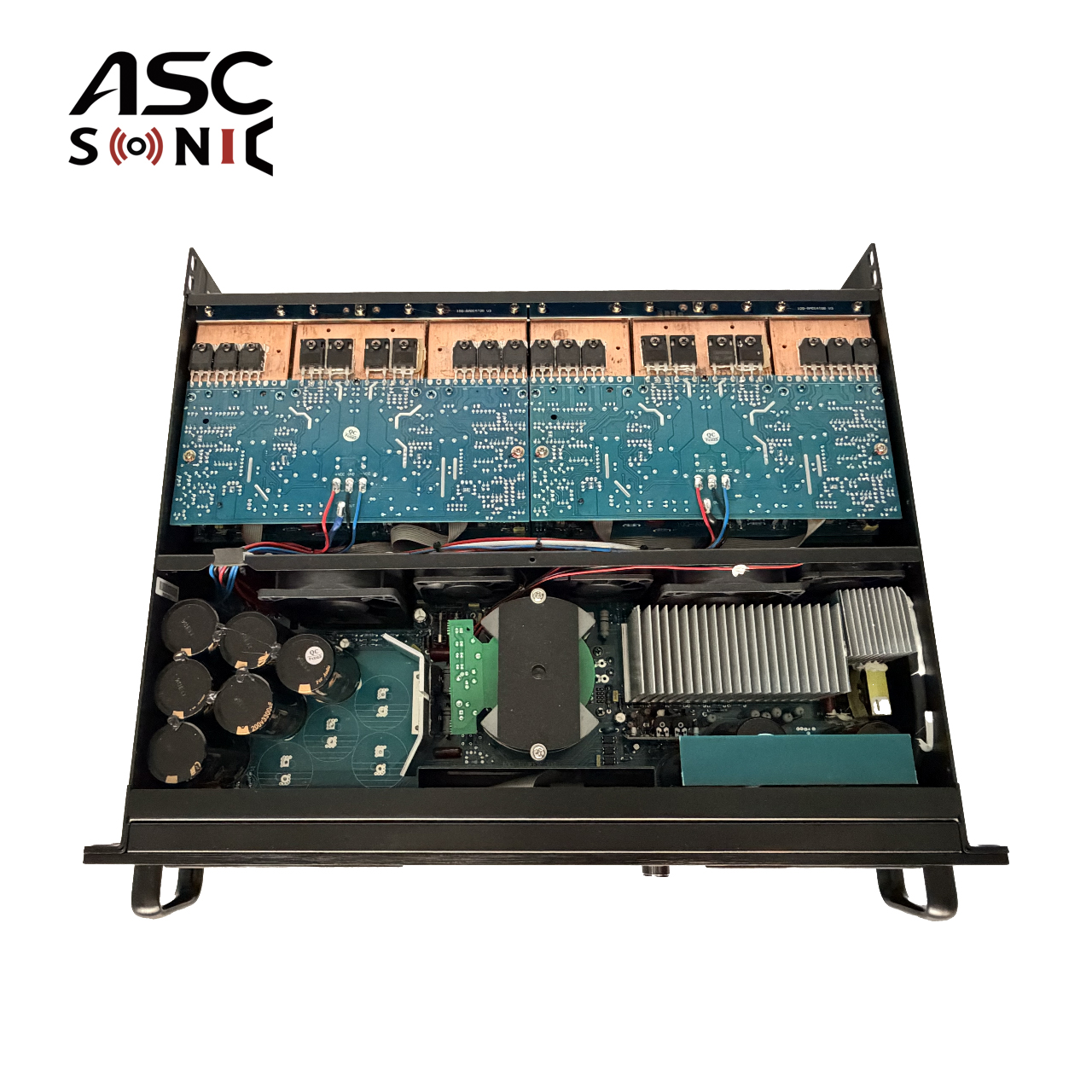
Physical footprint remains a premium constraint in commercial AV. Standard stereo amplifiers occupy two rack units for just two channels. Scaling up to a complex multi-zone system using stereo units quickly exhausts available rack space. Multi-channel chassis consolidate components. They allow multiple amplification modules to share a single, massive internal power supply.
The role of the 4 Channel Power Amplifier proves vital in modern system architecture. It solves specific deployment challenges while saving rack space.
Bi-amping complex loudspeaker systems: Large speakers separate internal components into distinct high-frequency and low-frequency drivers. A four-channel unit lets you dedicate one channel to the tweeter and one channel to the woofer, ensuring distinct control.
Driving multi-zone commercial audio: Hospitality venues require distinct volume levels across lobbies, bars, patios, and dining rooms. One four-channel unit easily manages four separate acoustic zones.
Powering surround arrays: Theatrical installations require discrete ceiling and rear-fill speakers. High channel density simplifies the wiring paths.
You must evaluate internal topology carefully. Check for discrete power supplies per channel versus shared electrical rails. Shared rails present a distinct risk. If all channels drive heavy sub-bass simultaneously, the shared power supply may sag. This voltage drop starves the channels, leading to momentary clipping or shutdown.
Finally, assess bridging capabilities. Bridging combines two amplifier channels into a single mono output. It effectively doubles the voltage swing. This configuration proves excellent for driving massive subwoofer loads. However, bridging halves the amplifier's minimum impedance tolerance. If your unit safely handles 4-ohm loads in stereo, bridging it usually requires an 8-ohm minimum load. Failing to observe this limit triggers thermal shutdown.
Traditional sound systems require racks full of outboard gear. Engineers historically chained external equalizers, analog crossovers, and dedicated system limiters before hitting the final output stage. This analog chain introduced noise, required dozens of patch cables, and presented multiple points of failure.
The industry rapidly replaced this outdated methodology. Integrating processing directly into the output stage eliminates redundant outboard gear. A modern Digital DSP Power Amplifier keeps the signal perfectly digital until the final output conversion. This preserves incredible acoustic fidelity.
You should evaluate several core processing features when reviewing these platforms:
Parametric EQ & Delays: Every physical room suffers from acoustic anomalies. Parametric equalizers let you surgically cut resonant frequencies. Furthermore, sound travels slowly. Large venues require time alignment. Millisecond delays sync the rear-fill speakers to the main front array, preventing muddy echoes.
Crossovers & Limiters: You must protect physical loudspeaker drivers from receiving the wrong frequencies. Crossovers route bass exclusively to subwoofers and treble exclusively to tweeters. Limiters serve as the final safety net. They act as brick walls, managing safe peak-voltage and preventing sudden transient spikes from blowing voice coils.
Network and compliance integration also dictate modern procurement. Look for Dante or AES67 compatibility. These protocols send hundreds of uncompressed audio channels over standard ethernet cables, replacing heavy analog copper snakes. Remote telemetry monitoring provides immense value. IT helpdesks can view real-time thermal data, impedance changes, and fault-logging events from across the campus. Proactive monitoring prevents embarrassing mid-show failures.
Technical buyers face a barrage of confusing marketing metrics. Manufacturers often disguise inadequate internal components behind inflated numbers. You must cut through the noise and base your decisions on standardized, rigorous testing metrics. Use this framework to evaluate any prospective unit.
Disregard "Peak" or "Max" marketing numbers immediately. Peak ratings measure a fraction of a second of output before the internal power supply collapses. They hold no value for continuous operation. Base your decisions strictly on Continuous RMS power. Demand numbers rated at your specific load impedance (e.g., 4Ω or 8Ω). Crucially, the RMS rating must span the full auditory bandwidth (20Hz to 20kHz). An amplifier might deliver 1000 watts at a simple 1kHz test tone, but only manage 600 watts across a full musical spectrum.
As units approach their maximum output, they alter the original wave shape. This introduces harmonic distortion. Demand verifiable metrics rather than loose estimates. A professional-grade unit should maintain a THD+N of less than 0.05% when driven at half power. Anything higher suggests poor internal component quality and will result in listening fatigue for the audience.
All electronic circuits generate a baseline level of thermal noise, commonly heard as a faint hiss. Ensure an SNR of greater than 100dB for professional applications. This ratio guarantees a completely silent noise floor. A high SNR remains absolutely critical in corporate boardrooms, recording studios, and theatrical environments where ambient room noise is exceptionally low.
Calculate your required AC mains circuits carefully. High-output units easily trip standard 15-amp breakers during heavy transients. Additionally, evaluate the HVAC load based on the amplifier’s thermal dissipation, measured in BTU/hr. Check the manufacturer's spec sheet for heat output at idle and at 1/8th continuous power. Ensure your rack exhaust fans and room air conditioning can comfortably extract this waste heat.
Choosing the right hardware requires moving far beyond basic wattage numbers. You must critically evaluate class efficiency, channel density, and onboard processing capabilities to ensure operational stability. A poorly specified unit compromises your entire signal chain, leading to thermal shutdowns and ruined hardware. Embracing modern, highly efficient topologies ensures your venue runs cleanly and reliably.
Technical buyers should take immediate action to secure their infrastructure. First, audit your required load impedance across all loudspeaker zones. Second, calculate your available physical rack space and thermal headroom limits. Finally, always request engineering spec sheets featuring certified RMS testing data before committing to a new platform.
A: Peak power represents a brief, unsustainable burst of energy measured over fractions of a second. It is largely a deceptive marketing metric. Continuous (RMS) power measures the amplifier’s ability to deliver sustained, stable current over long durations. Always base your purchasing decisions and reliability calculations strictly on RMS ratings across a full frequency bandwidth.
A: Yes. A mixer handles signal routing, summing, and artistic EQ. It does not provide dedicated loudspeaker management. Onboard DSP acts as a crucial safety layer. It offers precise driver protection, brick-wall limiting, time-alignment delays, and specialized crossovers tailored exactly to the physical limitations of your speakers.
A: Yes, most professional multi-channel units support bridging. Bridging combines two channels to double the voltage swing, heavily increasing output power for large subwoofers. However, bridging alters the minimum impedance handling. A unit stable at 4 ohms in stereo usually requires an 8-ohm load when bridged to prevent dangerous thermal overload.
A: Class D utilizes rapid switching technology to achieve up to 90% electrical efficiency. This drastically reduces waste heat, eliminates massive copper transformers, and lowers AC power draw. The resulting units weigh significantly less and require less aggressive HVAC cooling, making them ideal for dense, large-scale commercial deployments.


