
Views: 0 Author: Site Editor Publish Time: 2026-09-01 Origin: Site


The commercial and residential audio sectors have experienced a massive technological paradigm shift over the past decade. Once relegated strictly to booming subwoofers or budget consumer electronics, the Class D Power Amplifier now thoroughly dominates both high-end audiophile listening rooms and dense commercial Pro AV racks. Traditional Class A and Class AB amplifier architectures suffer from massive thermal inefficiency. They inherently require heavy heat sinks, massive toroidal copper transformers, and large, unwieldy chassis just to safely dissipate wasted energy.
Today, discerning buyers demand extreme power density but refuse to sacrifice objective, verifiable audio quality. This modern switching technology directly solves the thermal dilemma. It successfully moves the purchasing conversation away from outdated subjective debates. We no longer ask if these models sound good. Instead, we ask which specific configuration best fits our deployment scale. You will discover exactly how pulse-width modulation drives this acoustic revolution. We will explore the mechanics of high-speed switching, thermal advantages, measurable performance metrics, and vital configuration options to guide your next system integration.
Switching Technology: Class D operates by rapidly switching transistors on and off using Pulse Width Modulation (PWM), distinct from the continuous current of Class A/AB.
Unmatched Efficiency: Achieves 90% or higher electrical efficiency, drastically reducing thermal output and power consumption.
Measurable Accuracy: Modern implementations (using advanced feedback loops) yield exceptionally low distortion (high SINAD), competing with or exceeding traditional audiophile benchmarks.
Deployment Flexibility: Highly scalable, making specialized configurations like a 4 channel Class D power amplifier or units with integrated DSP the standard for complex system integrations.
Understanding this architecture requires looking closely at how it processes an incoming audio signal. We must discard the traditional concept of continuous current flow. Instead, engineers rely heavily on a highly efficient mathematical process.
The system fundamentally operates on Pulse Width Modulation (PWM). A comparator circuit receives the continuous, incoming analog audio waveform. It simultaneously receives a very high-frequency triangle wave generated by an internal oscillator. The comparator analyzes both signals simultaneously. It then converts the original audio signal into a rapid sequence of square waves. We call these waves pulses. A high signal amplitude creates wider pulses. A lower signal amplitude creates narrower pulses. This clever modulation allows the system to encode highly complex musical waveforms into simple, discrete timing pulses.
The output stage utilizes specialized MOSFET transistors. Unlike Class AB designs, these output transistors never operate in a linear, partially open state. They act strictly as ultra-fast switches. They flip fully "on" or fully "off" hundreds of thousands of times per second. Because they spend practically zero time in the middle resistive state, they avoid burning off energy as heat.
Expertise Note: A common misconception persists across the market. Many buyers incorrectly assume the "D" stands for digital. It absolutely does not. The entire operation remains a strictly analog switching process. The transistors replicate the analog signal's amplitude physically via pulse width, rather than utilizing binary data strings. It is crucial to understand this distinction when designing high-fidelity analog chains.
You cannot send raw, high-frequency square waves directly into a delicate loudspeaker. The massive switching frequencies would overheat tweeters and destroy crossover networks. Therefore, engineers implement a critical LC (inductor-capacitor) network. This circuit sits at the very end of the output stage. It acts as a strict, passive low-pass filter. The inductor blocks the high-frequency switching noise. The capacitor shunts remaining high-frequency artifacts safely to the ground plane. Together, they strip away all switching artifacts. This filter perfectly reconstructs the clean, amplified analog audio signal for your speakers.
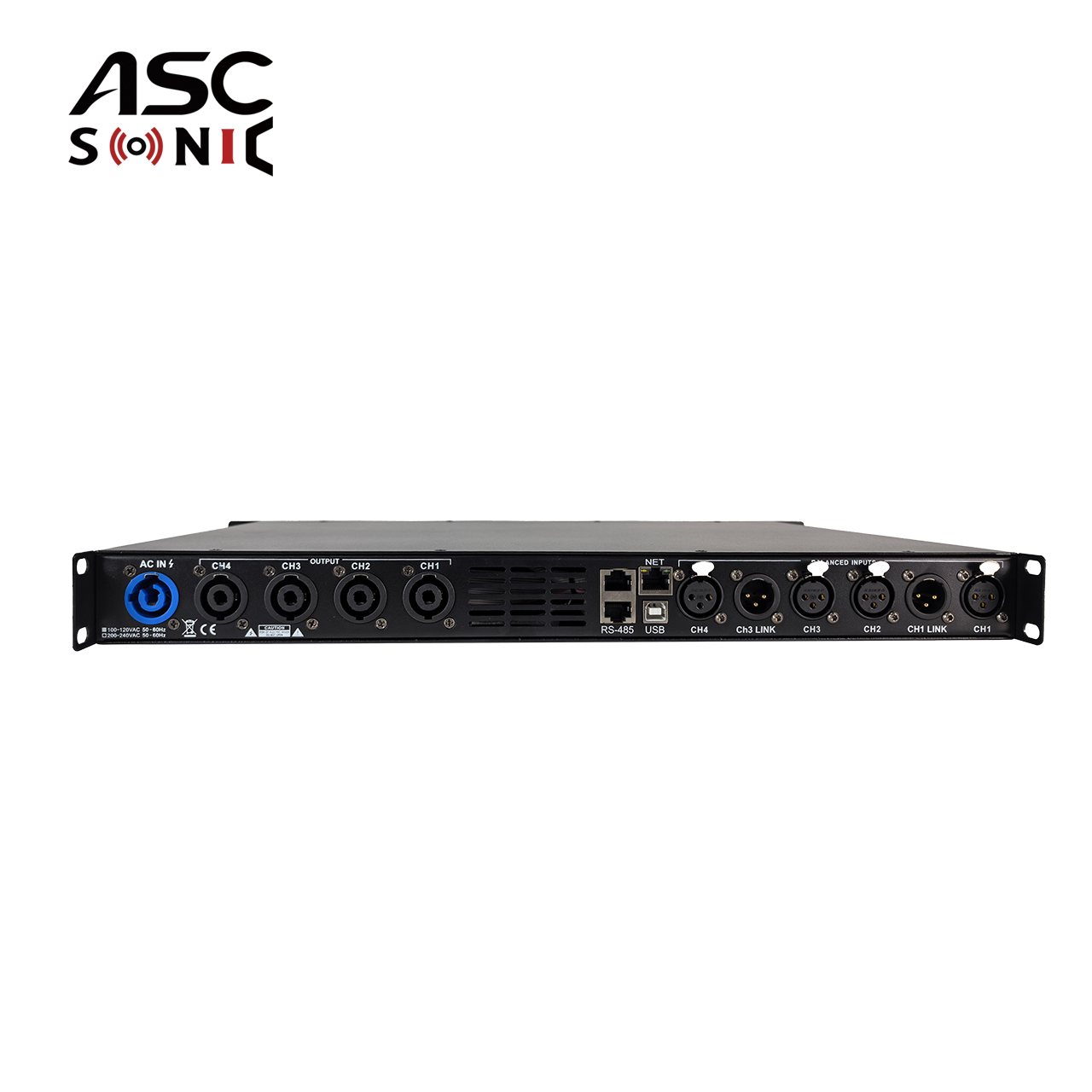
System integrators face constant battles regarding rack space, weight limits, and ventilation requirements. This technology drastically alters how professionals plan and deploy audio infrastructure in physical environments.
Let us closely examine the electrical conversion rates. A traditional Class AB amplifier typically maxes out between 50% to 65% efficiency. It converts the remaining electrical power directly into pure heat. Conversely, a modern switching design easily achieves 90% or higher electrical efficiency. Almost every single watt pulled from the wall translates directly into usable audio output. You waste very little energy.
This extreme efficiency fundamentally alters physical product design and logistics. Engineers no longer need to specify massive external aluminum cooling fins. They can completely eliminate heavy toroidal transformers. You receive a much lighter chassis. Installation technicians greatly appreciate lifting a 15-pound unit instead of struggling to rack a 60-pound monolith. It costs significantly less in freight to ship these units globally. Integrators can securely pack more audio channels into highly confined spaces without risking thermal shutdown.
Amplifier Class Efficiency and Thermal Comparison
| Metric | Class AB Architecture | Class D Architecture |
|---|---|---|
| Peak Efficiency | 50% - 65% | 90% - 95% |
| Thermal Dissipation | Very High | Very Low |
| Heat Sink Requirement | Massive / Heavy Fins | Minimal / Internal |
| Power Supply Type | Heavy Toroidal Transformer | Lightweight Switch-Mode (SMPS) |
| Rack Space Density | Low (Requires significant airflow gaps) | High (Often fits 1U per unit) |
Commercial venues, theaters, and enterprise server-rack AV integrations routinely face severe heat-density problems. A High Power Class D Amplifier provides the ultimate solution. It can effortlessly deliver thousands of continuous watts. Amazingly, it fits entirely within a standard 1U or 2U rack space. This drastically reduces the need for expensive, dedicated HVAC cooling zones just for the audio equipment racks.
Historically, audiophiles and system designers viewed switching amplifiers with extreme skepticism. We must separate outdated historical myths from current engineering realities.
Early generations suffered from a specific, measurable engineering flaw. Their frequency response depended heavily on the attached loudspeaker's electrical impedance. The high-frequency response might roll off noticeably on a 4-ohm speaker. Conversely, it might peak aggressively on an 8-ohm speaker. This load dependency created a persistent myth. Reviewers constantly described switching architectures as having a "harsh treble" or brittle high-end. This was true decades ago, but it no longer applies to modern designs.
Today's top-tier architectures solve the load dependency problem completely. Industry-leading modules designed by engineering pioneers (like those found in Hypex, Purifi, and ICEpower architectures) utilize highly advanced post-filter feedback loops. They capture the audio signal after it passes through the LC reconstruction filter. The amplifier precisely compares this final output to the original input source. It instantly corrects any detected errors or distortions. This complex closed-loop mechanism ensures the frequency response remains perfectly flat, regardless of speaker impedance fluctuations.
We strongly guide buyers to evaluate objective data rather than relying on outdated subjective biases. Look closely at established metrics sanctioned by the Audio Engineering Society (AES). You should prioritize high SINAD (Signal-to-Noise and Distortion Ratio) scores. You must review the THD+N (Total Harmonic Distortion plus Noise) charts across the entire frequency band. Modern implementations routinely yield exceptionally low distortion. They easily compete with or exceed traditional, high-priced audiophile benchmarks. However, transparently speaking, poorly designed budget units can still exhibit audible noise floors. Component quality always dictates final performance.
Because the core technology scales so elegantly, manufacturers offer a wide variety of form factors. You must select the configuration tailored perfectly to your specific deployment needs.
Audiophiles and critical listening rooms traditionally prefer stereo or mono block configurations. These separate chassis isolate the power supplies entirely. They prioritize maximum channel separation. This prevents any potential crosstalk between the left and right speakers, preserving an ultra-wide soundstage.
Installers managing complex systems often require massive channel density. A 4 Channel Class D Power Amplifier serves as the definitive go-to solution. It handles commercial multi-zone audio distribution effortlessly. You can route independent audio feeds to a lobby, bar, patio, and dining room using just one single rack unit. Furthermore, these units expertly power active speaker bi-amping configurations. Home theater enthusiasts heavily rely on them to drive demanding Dolby Atmos surround sound arrays while minimizing rack footprint.
Modern deployments increasingly demand intelligent system management. A Class D DSP Power Amplifier integrates powerful Digital Signal Processing directly alongside the output modules. This integration offers an immense value proposition.
Internal Crossovers: Integrators can digitally assign high-pass and low-pass crossover points for subwoofers and mid-range drivers internally.
Parametric EQ: You can apply precise equalization curves to flatten speaker response.
Time Alignment: You can precisely delay signals to ensure audio from different speaker arrays hits the listener simultaneously.
Hardware Reduction: Handling all acoustic corrections before the signal hits the amplification stage drastically reduces the need for external outboard gear.
Not all switching designs are created equal. You must know exactly what to look for when reviewing manufacturer specification sheets to ensure long-term reliability.
You must actively verify load invariance. Instruct your engineering team to scrutinize the spec sheet. The frequency response graph must show identical, flat lines across both 4-ohm and 8-ohm loads. If the high-frequency line deviates wildly based on the impedance, discard that model. It uses outdated filter technology.
The amplifier module is only as capable as its internal Switch-Mode Power Supply (SMPS). You need robust continuous power ratings. Do not rely solely on peak "dynamic" burst specifications. A weak SMPS will cause bass frequencies to clip prematurely during demanding passages. Ensure the manufacturer publishes continuous RMS ratings driven into all channels simultaneously.
Watch out for several common pitfalls during system specification.
EMI/RFI Shielding: Unshielded switching designs act like unintended radio transmitters. They can leak radio frequency noise into adjacent equipment. Ensure your shortlisted brands explicitly comply with rigorous FCC and CE emissions standards. The chassis must function as a proper Faraday cage.
Gain Matching: You must properly align input sensitivity. Ensure the amplifier's input stage matches your source equipment voltage. Mismatched gain structures inevitably create unacceptably high noise floors or cause early input clipping.
Before making a final purchasing decision, we advise you to follow a strict auditing process.
Audit your available physical U-space in the equipment rack.
Calculate your total continuous RMS wattage requirements based on speaker sensitivity and desired SPL.
Determine the exact impedance loads of your combined speaker arrays.
Assess whether onboard DSP will simplify your signal chain and improve your specific room acoustics.
A modern switching amplifier represents highly mature, proven technology. It efficiently solves real-world space, heat, and power density problems. It accomplishes all this without ever compromising objective audio fidelity. By understanding the core pulse-width modulation mechanics, you can confidently navigate the current market. We strongly advise moving forward only with manufacturers providing transparent, third-party verifiable measurement data. Always insist on units featuring robust, overbuilt switch-mode power supplies to guarantee long-term stability.
If you are ready to upgrade your infrastructure, take action now. Contact a dedicated sales engineer today for personalized rack-planning assistance. View our detailed comparison matrix of DSP models to find your perfect match. Alternatively, request a demo unit to evaluate this incredible thermal efficiency in your own facility.
A: No, it is not purely digital. The "D" simply stands for the fourth amplifier class assigned sequentially by engineers, following A, B, and C. It does not stand for "Digital." The technology operates via high-speed analog switching. It converts the continuous audio wave into a series of varying analog pulses. The entire amplification process happens in the analog domain, completely independent of binary data strings.
A: They do not run completely cold. While highly efficient (often exceeding 90%), the remaining electrical energy still converts into heat. They generate significantly less thermal output than traditional amplifiers. However, they still require sensible ventilation. You must leave some breathing room, especially when driving high sustained outputs in densely packed equipment racks to prevent thermal protection modes.
A: Both technologies utilize highly efficient, modern circuit topologies. Pairing them creates immense physical synergy. It allows manufacturers to combine comprehensive digital system management, precise crossover control, and massive power output into one single, compact chassis. This combination dramatically reduces rack space requirements, speeds up installation time, and eliminates the need for complex external processing equipment.


