
Views: 0 Author: Site Editor Publish Time: 2026-09-29 Origin: Site


The 2026 audio infrastructure landscape reveals a massive shift. We no longer rely on raw wattage alone. Today, we demand intelligent, network-managed audio distribution. System integrators and IT managers face a core problem. You must balance legacy hardware replacement costs against modern demands. Facilities need scalable and energy-efficient systems. They require easy centralized management. Old analog racks drain power and require tedious manual tuning. Modern environments require proactive monitoring. This article provides an evidence-based evaluation framework. We help you compare modern amplification features effectively prior to procurement. You will learn how network integration transforms system design. We will explore how onboard processing and advanced power management redefine commercial audio standards. You can use these insights to build a resilient, future-proof audio deployment.
Audio over IP is standard: Dante capability drastically reduces cabling costs and improves multi-zone scalability.
Efficiency matters: Power Factor Correction (PFC) is no longer optional for large-scale deployments due to grid stability and thermal management requirements.
Centralized control wins: Network DSP integrations eliminate outboard gear, reducing points of failure and simplifying tuning.
Maintaining analog, non-networked amplification systems carries significant hidden costs. Older systems rely heavily on physical copper wiring. They lack modern telemetry data. When a channel fails, technicians must physically visit the equipment rack to diagnose the problem. This approach requires high labor hours for initial tuning. It also demands constant physical intervention for ongoing maintenance. Furthermore, legacy Class-AB designs consume excessive energy. They generate immense heat. This heat forces your HVAC systems to work harder, driving up facility utility bills.
A successful modern upgrade requires clear success criteria. You should look for a measurable drop in fault-resolution time. Technicians must be able to view system health remotely. You also want lower thermal output across your AV racks. Finally, the upgrade must ensure seamless integration into existing AV control environments. Hardware silos are no longer acceptable. The entire ecosystem must communicate smoothly.
We must establish baseline expectations for commercial audio procurement today. You should demand Class-D efficiency paired with digital intelligence. A modern Power Amplifier operates as a smart IT node. It does not just push current to loudspeakers. It reports its health, adapts to digital routing, and protects the connected hardware. Upgrading in 2026 means abandoning "dumb" copper-driven systems. We move toward edge-managed digital endpoints.
Upgrading amplifiers without upgrading the underlying network switch infrastructure.
Ignoring HVAC load calculations when removing older, hotter analog equipment.
Failing to consult the IT department regarding network security protocols before deploying AV-over-IP.
Audio over IP solves numerous logistical headaches. Integrating Dante directly into the amplifier architecture changes everything. It shifts audio routing from physical copper lines to standard IT networks. You no longer need massive bundles of heavy speaker cables running back to a central matrix. Instead, you distribute your endpoints strategically.
This features-to-outcomes mapping highlights the immediate benefits. First, you drastically reduce infrastructure requirements. A single CAT5e or CAT6 cable handles both control data and multi-channel audio delivery. Second, you achieve profound interoperability. A Dante Power Amplifier executes seamless handshakes with third-party digital consoles, DSP matrices, and networked microphones. You can route any input to any output using intuitive software rather than physical patch bays.
However, you must manage specific implementation risks. You need proper network switch configurations. Enterprise IT environments require strict Quality of Service (QoS) rules. You must verify Power over Ethernet (PoE) budgets if using Dante adapters elsewhere in the chain. Furthermore, IGMP snooping is mandatory to prevent multicast traffic from flooding your network. You must secure IT department buy-in early. If IT restricts multicast traffic, you will experience severe packet dropouts and audio artifacts.
Always isolate Dante traffic on a dedicated Virtual Local Area Network (VLAN).
Disable Energy Efficient Ethernet (EEE) on all switches handling audio packets.
Keep switch hops to a minimum to ensure ultra-low latency timing limits.
Regularly audit Dante Controller software to verify clock leadership elections.
Modern system design moves digital signal processing away from central racks. We now push processing out to the edge. Edge processing means housing the DSP directly inside the amplification unit. This consolidation saves physical rack space. It eliminates external matrix processors and cuts down on analog patch cabling. It also reduces the potential noise floor introduced by multiple analog conversions.
You must evaluate onboard DSP across several critical dimensions. First, look for granular room tuning capabilities. An advanced Network DSP Power Amplifier provides deep parametric EQ, precise alignment delay, and FIR filtering. FIR filters allow phase correction without altering the frequency response. This is essential for tuning large line arrays in complex acoustic spaces.
Second, prioritize robust loudspeaker protection. Onboard DSP monitors the output in real time. It deploys voltage and current limiters to prevent driver blowouts. Third, demand remote telemetry. You must be able to monitor impedance shifts, operating temperatures, and clipping states via a secure web GUI. Remote telemetry saves money because you avoid rolling a truck for minor diagnostic checks.
Consider trust and assumptions carefully. Onboard DSP clearly saves rack space. However, proprietary software interfaces introduce the risk of vendor lock-in. You might become trapped in a closed ecosystem. Therefore, open-API support is absolutely critical. Ensure the hardware supports third-party control modules from platforms like Crestron, Q-SYS, or Extron. Open-API protocols allow you to merge audio telemetry into your broader building management systems.
Table 1: Traditional Audio Setup vs. Edge Processing Architecture
| Evaluation Metric | Traditional Centralized DSP | Network DSP Amplification |
|---|---|---|
| Points of Failure | High (Multiple devices, patch cables) | Low (Consolidated hardware, network routed) |
| Rack Space Utilization | Requires 4-6 RU for processors and amps | Requires 1-2 RU total |
| Signal Degradation | Potential analog noise between stages | Digital path preserved until final output |
| Telemetry Data | Limited or disjointed across platforms | Unified via single web interface |
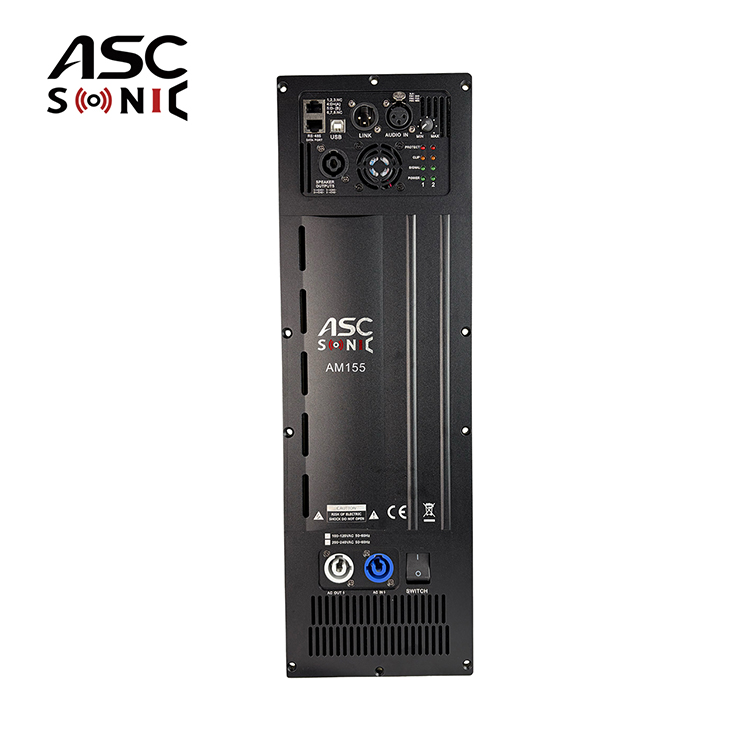
High-output audio systems demand massive amounts of electricity. Standard power supplies often draw current inefficiently. They pull current in sharp spikes, causing the voltage and current waveforms to fall out of phase. Power Factor Correction (PFC) solves this problem. A PFC circuit actively aligns the voltage and current waveforms. This maximizes the power draw efficiency from the AC mains. It ensures the equipment uses almost all the power it pulls from the wall.
The features-to-outcomes map for PFC highlights massive facility benefits. First, you gain grid stability. A PFC Power Amplifier draws consistent power regardless of minor AC voltage fluctuations. This is critical for global deployments or venues with unstable grids. Generators and Uninterruptible Power Supplies (UPS) operate much more reliably when connected to PFC loads.
Second, you achieve profound thermal and energy efficiency. Standard systems waste energy as reactive power. Reactive power does no actual work but heats up the cables and the rack. PFC reduces this wasted reactive power. Less heat means your HVAC cooling costs drop significantly. The power supply runs cooler, extending the lifespan of internal capacitors and transistors.
We must look at compliance and authoritativeness. Energy compliance standards strictly scrutinize power factors. Frameworks like Energy Star for AV equipment and RoHS heavily favor active PFC designs. Enterprise and government bids often mandate high power factors. Facilities face strict energy caps. Specifying PFC equipment ensures you meet international efficiency codes while delivering peak audio performance.
You must weigh integration considerations carefully during procurement. Do not evaluate initial hardware costs in a vacuum. You should weigh them against installation labor reductions. Networked edge devices require fewer cable pulls. They eliminate extensive physical patching. Maintenance efficiency also improves. Remote monitoring capabilities reduce emergency service calls. Technicians can reboot devices or adjust limiters from a laptop miles away.
Vendor evaluation requires strict due diligence. Assess how frequently the manufacturer releases firmware updates. Frequent updates indicate an active software development team patching security vulnerabilities. Evaluate the responsiveness of tier-2 technical support. When network routing fails during a live event, you need immediate engineering assistance. You should also scrutinize the component warranty lengths. Five-year warranties show manufacturer confidence in their thermal design and capacitor selection.
We strongly recommend a pilot testing phase. Do not deploy a large-scale system without validating the manufacturer's claims in your specific environment.
Request Demo Units: Secure two identical endpoints from your shortlisted vendors.
Test Network Discovery Speed: Connect the units to your test VLAN. Measure how fast Dante Controller recognizes the devices.
Evaluate GUI Usability: Task a junior technician with setting a basic crossover and limiter. Assess if the web GUI is intuitive or needlessly complex.
Simulate Thermal Load: Run pink noise through the system at 80% capacity for four hours. Monitor the onboard temperature telemetry and note any thermal throttling.
Verify API Integration: Send basic string commands from your control system (e.g., mute, volume up) and measure response latency.
The best amplification hardware for 2026 operates as an intelligent IT node. It is no longer just a high-current provider. We have shifted from raw power to smart power. Network integration allows for massive scalability and reduced cabling infrastructure. Onboard DSP processing eliminates external points of failure. It provides pristine tuning capabilities right at the edge. Active power correction ensures maximum energy efficiency and grid stability.
You must map your specific venue requirements against these advanced features. Consider your existing network topology. Evaluate your current AV control platforms. Assess your facility's power availability and HVAC limits. Every deployment presents unique acoustic and electrical challenges.
Your next steps require deliberate action. Gather your facility documentation. Contact an experienced AV consultant for a comprehensive site audit. Request detailed spec-sheet comparisons from your shortlisted manufacturers. Demand equipment that integrates seamlessly into your IT environment. Smart procurement today guarantees a resilient, manageable, and high-performance audio system for the future.
A: While Dante can run on a converged network, a dedicated VLAN with strict QoS rules is highly recommended. Enterprise environments handle massive data traffic. Isolating audio packets ensures zero latency. It prevents IT data bursts from causing audio dropouts during critical events.
A: Onboard processing typically eliminates 1 to 2 RU of external matrix processors per audio zone. It cuts down on heavy patch cabling. Removing external processing also removes potential analog noise floors, giving you a cleaner signal path in a much smaller physical footprint.
A: The addition of active switching circuitry to regulate AC input increases manufacturing costs. However, this technology pays for itself through reduced breaker tripping and lower facility cooling requirements. The stabilized power draw also prolongs internal component lifespan, preventing premature hardware failure.


