
Views: 0 Author: Site Editor Publish Time: 2026-08-26 Origin: Site


Transitioning from passive speaker design to a fully active system shifts the burden of crossover management and power delivery directly to the amplifier. You no longer rely on inductors and capacitors to split frequencies inside the cabinet. Instead, the amplifier takes total control over what signal reaches which driver. Selecting an active module with the incorrect channel count forces compromises in system architecture. You either rely on unwanted passive crossover components or overspend on unused amplification channels, creating unnecessary thermal load.
This guide provides a technical framework for mapping speaker configurations to amplifier channels. We evaluate asymmetrical power distribution and show how leveraging a DSP plate amplifier finalizes your system architecture. We break down exactly how to match your driver array to the right amplification module for optimal acoustic performance.
The 1-to-1 Mapping Rule: True active systems require one dedicated amplifier channel for every independently crossed-over driver (or identical driver array) in the speaker enclosure.
Asymmetrical Power Requirements: Multi-channel plate amplifiers rarely offer equal wattage across all channels; they are designed to deliver high power to low-frequency drivers and lower power to high-frequency tweeters.
DSP Integration is Mandatory for Multi-Way: A multi-channel active plate amplifier relies on integrated Digital Signal Processing (DSP) to route specific frequency bands, time alignment, and EQ to each individual channel.
Thermal and Spatial Constraints: Increasing channel count within a single plate amplifier increases the physical footprint and internal heat generation, requiring strict enclosure volume and ventilation calculations.
Understanding the relationship between acoustic "ways" and amplifier channels dictates your entire system design. In a traditional passive speaker, a single amplifier channel feeds a crossover network, which then splits the signal to the woofer and tweeter. Active amplification eliminates that passive network entirely. The crossover happens digitally before the signal ever reaches the amplification stage.
This brings us to the baseline 1-to-1 driver mapping rule. A true active 2-way speaker requires a 2-channel amplifier. A 3-way speaker requires a 3-channel amplifier. You assign one dedicated channel of amplification to each specific frequency band. You must also account for integrated subwoofers. If your speaker enclosure includes an internal subwoofer, that subwoofer counts as a distinct acoustic "way." It requires its own dedicated, high-power channel separate from the mid-bass woofer.
Many builders confuse total speaker count with required channel count. A speaker cabinet might contain four physical drivers: two woofers, one midrange, and one tweeter. This is a 3-way system, not a 4-way system. The two identical woofers share the exact same frequency band. You wire these dual mid-woofers in parallel or series to operate on a single amplifier channel. You do not need a 4-channel amplifier for this configuration; a 3-channel active plate amplifier handles it perfectly, provided the woofer channel can handle the combined impedance load.
To determine your exact channel requirements, follow these evaluation steps:
Count the number of distinct frequency bands your speaker will reproduce (e.g., low, mid, high).
Group any identical drivers that will play the exact same frequency range.
Calculate the combined impedance of those grouped drivers to ensure they can run on a single channel.
Assign one amplifier channel to each distinct frequency band.
Sometimes hardware limitations force a hybrid approach. You might want to build a 3-way speaker but only have access to a 2-channel plate amplifier. In this hybrid scenario, you actively cross the woofer on channel one. You then use channel two to power both the midrange and the tweeter, placing a traditional passive crossover between them. While this saves money and amplifier space, it introduces performance trade-offs. You lose the ability to digitally time-align the tweeter and midrange independently. You also reintroduce the phase shifts and power loss inherent to passive capacitors and inductors.
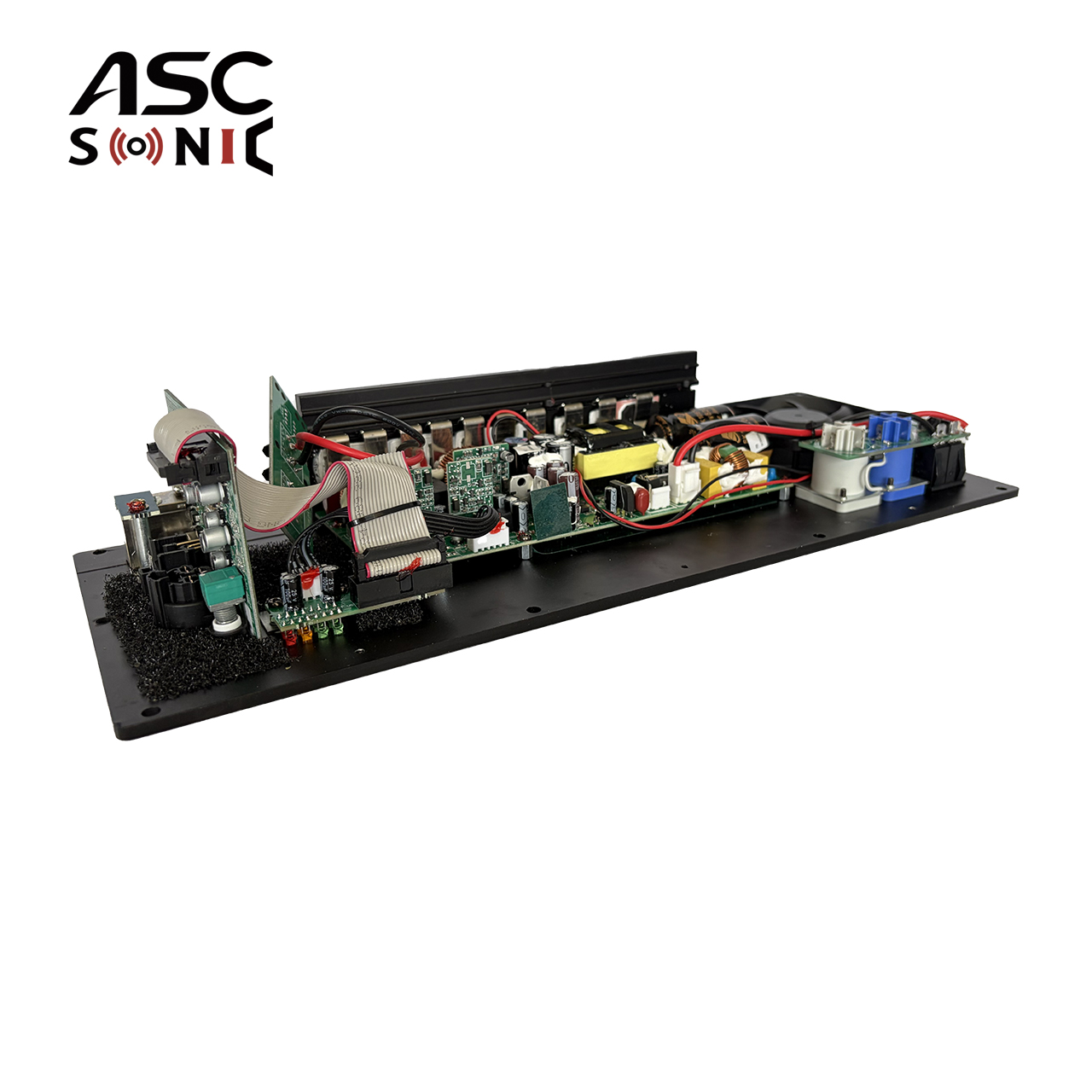
Matching the amplifier to the speaker requires looking beyond just the number of outputs. You must evaluate the power delivery, crossover capabilities, and physical footprint of the module. Different speaker architectures demand entirely different amplification strategies.
Monoblock plate amplifiers serve very specific, high-demand roles. You use them primarily for dedicated subwoofers or single full-range driver designs. You can also use a 1-channel module to power a fully passive multi-way speaker, effectively turning a passive cabinet into a powered one without active DSP crossovers.
When evaluating a 1-channel module for a subwoofer, prioritize high continuous power output (RMS) and low-frequency extension capabilities. Subwoofers demand massive current to control heavy cone mass at low frequencies. Efficiency matters heavily here. Sealed subwoofer enclosures offer zero airflow for cooling. The amplifier must operate efficiently to prevent thermal shutdown during heavy bass transients. Look for modules with thick aluminum faceplates that act as substantial heatsinks.
The 2-channel configuration dominates the active speaker market. You find these modules in standard 2-way active studio monitors, bookshelf speakers, and bi-amplified PA tops. They represent the sweet spot for compact, high-performance audio.
When selecting a 2-channel module, look for asymmetrical power delivery. A tweeter does not need 250 watts. A common and highly effective configuration delivers 250W to the woofer and 50W to the tweeter. This asymmetry matches the natural sensitivity differences between large cone drivers and small dome tweeters. You must also evaluate full-range considerations. If you plan to pair these 2-way tops with an external subwoofer later, the amplifier must allow you to apply precise high-pass filters via DSP to protect the mid-woofers from damaging sub-bass frequencies.
Stepping up to a 3-channel module opens the door to true 3-way active loudspeakers featuring a dedicated woofer, midrange, and tweeter. Alternatively, builders use 3-channel amps as 2.1 system hubs. In this setup, the amplifier sits inside a subwoofer cabinet, powering the internal sub with one high-power channel while sending stereo signals to a passive left and right pair via the remaining two channels.
Midrange channel clarity defines the quality of a 3-channel amplifier. The human ear is highly sensitive to the vocal frequency range handled by the midrange driver. You need crossover flexibility to define tight band-pass filters for that middle channel. Furthermore, the amplifier must handle varying impedance loads. You might run an 8-ohm tweeter, an 8-ohm midrange, and a 4-ohm woofer all off the same plate. The power supply must remain stable across these mixed loads without sagging voltage.
Complex 4-way tower speakers, large-scale line array modules, and dual-subwoofer/dual-top integrated systems require 4-channel plate amplifiers. These modules manage massive amounts of acoustic data and power.
Evaluation at this level requires scrutinizing advanced routing capabilities. The module needs high-end processing power to manage four distinct phase alignments and complex crossover slopes simultaneously. You must also account for significant physical footprint requirements. Four discrete channels of amplification require substantial heatsinking and board space. The internal wiring harness also becomes complex, requiring careful routing to avoid inducing noise into the signal path.
Pre-built 4-channel active plate amplifiers remain scarce on the consumer market. Due to this rarity, many builders turn to DIY alternatives. They utilize modular amp boards from manufacturers like Hypex or ICEpower, combining them with standalone DSP units to create custom multi-way builds. This approach requires advanced wiring skills but offers unlimited flexibility for extreme speaker designs.
Adding channels without control leads to acoustic chaos. The integration of digital signal processing transforms a basic multi-channel amplifier into a precision acoustic tool. It allows you to manipulate the audio signal in ways that physical crossover components simply cannot match.
A DSP Plate Amplifier eliminates the need for bulky, power-sapping passive crossover networks. Passive crossovers burn amplifier power as heat and introduce phase anomalies. DSP handles the frequency division in the digital domain, operating at line level before amplification.
Through a software interface, you assign specific frequency bands to corresponding physical channels. You set a High-Pass filter for the tweeter, a Band-Pass filter for the midrange, and a Low-Pass filter for the woofer. You can select steep 48dB/octave Linkwitz-Riley slopes that would be physically impossible to build with passive components. Internal architecture matters immensely here. The best DSP amplifiers feature a dedicated DAC (Digital-to-Analog Converter) per channel. This maintains absolute signal purity, ensuring the digital crossover calculations translate perfectly into analog voltage for the amplifier stage.
Comparison of Crossover Execution: DSP vs. Passive Networks
| Feature | DSP Active Crossover | Traditional Passive Crossover |
|---|---|---|
| Power Efficiency | High (No power lost to heat in components) | Low (Resistors and inductors burn wattage) |
| Slope Steepness | Up to 48dB/octave or higher | Typically limited to 12dB or 24dB/octave |
| Time Alignment | Microsecond digital delay per channel | Requires physical driver setback (stepped baffles) |
| Phase Correction | Instant digital inversion and phase EQ | Requires complex all-pass filter circuits |
| Adjustability | Real-time software adjustments | Requires desoldering and replacing components |
Physical driver placement creates timing issues. A tweeter's acoustic center usually sits further forward than a woofer's acoustic center. In a passive system, the sound from the tweeter hits your ear milliseconds before the sound from the woofer, smearing the audio image.
Multi-channel active setups provide a distinct advantage: the ability to delay individual channels at the DSP level. You can dial in microsecond delays on the tweeter channel to physically align its output with the woofer. DSP also handles phase inversion seamlessly. When using steep crossover slopes, phase wraps occur at the crossover point. DSP allows you to invert the phase of a single channel with a click, ensuring perfect driver integration and a flat frequency response across the crossover region.
Not all DSP chips deliver equal performance. Budget multi-channel amplifiers often feature underpowered DSP chips that struggle to manage 3 or 4 channels simultaneously. Processing overhead becomes a real bottleneck when you start applying multiple EQ bands and steep filters.
Advanced filtering, particularly FIR (Finite Impulse Response) filters, requires massive computational power. FIR filters allow for linear phase crossovers, but they demand high tap counts. If a budget DSP chip lacks the necessary processing power, applying complex EQ and FIR filters across four channels will introduce severe latency or digital artifacting. Always verify the processor specifications before committing to a high-channel-count DSP amplifier. Look for high sample rates (96kHz) and sufficient processing headroom.
Selecting the right amplifier requires matching electrical specifications to your specific driver array. Ignoring these technical dimensions leads to blown drivers or damaged amplifier modules.
You must calculate required wattage per channel based on driver sensitivity (dB/W/m) and intended maximum SPL. Tweeters typically boast high sensitivity, often hitting 92dB or more with just one watt. Heavy subwoofers might only produce 82dB with that same watt. To achieve a balanced sound, the subwoofer requires exponentially more power than the tweeter.
This explains why a 500W 3-channel amp is rarely split evenly. A symmetrical 166W/166W/166W split wastes power on the tweeter and starves the woofer. A properly designed asymmetrical amp will likely output 400W for the woofer, 75W for the midrange, and 25W for the tweeter. You must ensure this predefined power split matches your specific driver selection. If you pair a highly inefficient midrange with a highly efficient woofer, the predefined power asymmetry might work against you.
Running different nominal impedance drivers on the same multi-channel plate amplifier introduces significant risk. You might select an 8-ohm tweeter, a 6-ohm midrange, and a 4-ohm woofer. The amplifier must handle all three loads simultaneously.
Check the minimum stable impedance rating for each individual channel. Some budget amplifiers claim a 4-ohm stable rating, but that rating only applies to the main woofer channel. The tweeter channel might overheat if presented with anything lower than an 8-ohm load. Always verify the spec sheet for per-channel impedance stability to prevent thermal shutdown.
Certain 4-channel plate amplifiers offer bridging capabilities. Bridging ties two amplifier channels together to drive a single load, effectively doubling the voltage swing and power output. You can bridge a 4-channel amp into a 3-channel configuration (two bridged channels for a power-hungry woofer, two independent channels for mid and high) or a 2-channel configuration.
Bridging introduces thermal and impedance risks. When you bridge two channels, each internal amplifier sees half the connected impedance. If you connect an 8-ohm woofer to a bridged pair, each amp channel operates at 4 ohms. If you connect a 4-ohm woofer, each channel operates at 2 ohms. Many plate amplifiers cannot survive a 2-ohm load. The minimum impedance rating often doubles when bridging channels. Verify the bridged impedance limits before wiring.
Builders frequently underpower the low-frequency channel while overpowering the tweeter due to selecting symmetrical amplifier designs. Sending 200 watts to a 1-inch dome tweeter provides zero acoustic benefit and risks melting the voice coil. Meanwhile, sending only 200 watts to a 12-inch woofer leaves the system lacking dynamic punch and low-end extension.
Another common mistake involves maxing out channel counts without verifying the power supply capacity. An amplifier might boast four channels rated at 250W each. However, the internal power supply might only be rated for 600W total continuous output. If you drive all four channels simultaneously at peak loads, the power supply will sag, causing distortion, clipping, and potential system failure. Always check the total power supply rating against the sum of the channel ratings.
Typical Amplifier Channel Configuration and Power Distribution
| Channel Count | Primary Application | Typical Power Distribution (Example) | DSP Routing Requirement |
|---|---|---|---|
| 1-Channel | Dedicated Subwoofer | 1000W (Symmetrical) | Low-Pass, Subsonic Filter, Parametric EQ |
| 2-Channel | 2-Way Active Monitor | 250W LF / 50W HF (Asymmetrical) | Low-Pass, High-Pass, Time Delay |
| 3-Channel | 3-Way Tower / 2.1 System | 400W LF / 100W MF / 50W HF | Low-Pass, Band-Pass, High-Pass, Phase Alignment |
| 4-Channel | 4-Way System / Dual Sub+Top | 500W / 250W / 100W / 50W | Complex Matrix Routing, FIR Filtering, Global Delay |
Integrating complex electronics into a vibrating wooden box full of pressurized air requires careful mechanical and thermal planning. You cannot simply cut a hole in the back of a cabinet and screw the amplifier in without considering the physical environment.
Packing 3 or 4 amplifier modules into a single aluminum backplate generates intense heat. Class-D amplifiers run efficiently, but they still produce thermal waste, especially when driving low-impedance woofers at high volumes.
You must implement strict mitigation strategies. Calculate the internal enclosure volume to ensure enough air exists to absorb radiant heat. Never mount a high-power multi-channel amplifier in a tiny, sealed bookshelf cabinet without external heatsink ventilation. The aluminum plate itself acts as the primary heatsink. Ensure the plate has adequate surface area and external fins exposed to ambient room air. If the amplifier overheats, the DSP will throttle power or shut down the system entirely.
Mounting a multi-channel active plate amplifier directly inside a high-SPL speaker cabinet places severe mechanical stress on the electronics. The internal air pressure changes violently as the woofer moves. This pressure flexes the amplifier's aluminum plate and batters the internal circuit boards.
Vibration causes microphonics in capacitors and can physically break solder joints on heavy components like inductors and transformers. To mitigate this, you must build a separate, sealed sub-chamber within the speaker cabinet. Use 18mm MDF or birch plywood to construct a box behind the amplifier plate. This chamber isolates the amplifier's PCB and sensitive DSP components from the main acoustic volume. Route the speaker wires through sealed holes using silicone or rubber grommets to maintain airtight integrity. This isolation protects the electronics from pressure waves and extends the lifespan of your multi-channel investment.
Map your physical drivers to determine the exact number of independent frequency bands your system requires.
Calculate the combined impedance of any parallel-wired drivers to ensure they fall within the amplifier's safe operating range.
Select an amplifier with asymmetrical power distribution that matches the specific sensitivity ratings of your tweeters and woofers.
Verify that the internal DSP has enough processing power to handle your required crossover slopes and time alignment without latency.
Design and build a sealed, ventilated sub-chamber inside your speaker cabinet to protect the amplifier from internal air pressure and vibration.
A: Yes, but it requires a hybrid approach. You use one active channel for the woofer and the second active channel to power both the midrange and tweeter. You must place a traditional passive crossover between the midrange and tweeter to split the frequencies. This compromises your ability to apply DSP time alignment to the tweeter independently.
A: Amplifiers use asymmetrical power distribution because different drivers have different power requirements and sensitivities. A large woofer requires massive wattage to move heavy cone mass and produce low frequencies. A small tweeter is highly sensitive and requires very little wattage to produce high frequencies at the same volume level.
A: Yes. An integrated subwoofer operates in a completely different frequency band than the mid-bass woofers. It requires dedicated DSP low-pass filtering, subsonic protection, and significantly more power. It must be treated as a distinct acoustic "way" and assigned its own high-power amplifier channel.
A: Bridging combines two amplifier channels to drive a single load, effectively doubling the power output. However, it also halves the impedance load seen by each internal amplifier. If you bridge an amp into a 4-ohm speaker, the internal amps operate at 2 ohms. You must verify the amplifier is stable at these lower bridged impedances to prevent thermal failure.
A: High-SPL speakers generate massive internal air pressure and violent vibrations. Exposing the amplifier's circuit boards directly to this environment causes mechanical stress. It can break solder joints, induce microphonics in components, and cause air leaks around the amplifier plate. A sealed sub-chamber protects the electronics and maintains cabinet integrity.
A: Yes, if they play the exact same frequency band. You can wire them in parallel (which halves the impedance) or in series (which doubles the impedance). You must ensure the resulting combined impedance falls within the safe operating range of that specific amplifier channel.


